World cinema was dealt a major blow with the passing of Vicente Aranda in May of 2015. One of the biggest names in Spanish cinema and one of the founders of the Barcelona School of Film, Aranda’s name was well respected amongst fans of European horror thanks in no small part to Aranda’s legendary The Blood Splattered Bride (1972), based on Le Fanu’s Carmilla. Prior to Blood Splattered, Aranda had proven to have a knack for unusual genre based material as evidenced by The Exquisite Cadaver (1969), a film which seems like a trial run for Blood Splattered in parts, as well as the futuristic, avant-garde classic Fata Morgana (1965). Aranda’s stock continued to rise in Spain throughout the 70’s and 80’s with a variety of post-Franco regime transgressive films, one such title being the daring Sex Change (1976), which began his long and fruitful collaboration with actress Victoria Abril. Aranda hit pay dirt in the early 90’s with Amantes (1991), which found massive success in Spain and abroad at various festival worldwide, winning various awards including the Goya (Spanish Oscar) for best picture and best director. The 90’s would prove to be Aranda’s greatest period. Aranda followed Amantes with a series of fierce variations on a theme with 1993’s Intruso being one of Aranda’s finest, not to mention exceptionally grim treatments on the obsessions that would come to define Aranda's post-Amantes work.
While sitting in traffic, Louisa, a happily married mother of two, suddenly catches a glimpse of her former husband Ángel appearing sick, homeless and desperate. During their childhood, Louisa and Ángel, along with Louisa current husband Ramiro, were known collectively as “The Inseparables”, with Louisa and Ángel eventually marrying. The marriage however was short lived, and following the divorce Louisa married Ramiro and started a family. After seeing Ángel in such a sad state, Louisa is overcome with remorse and takes Ángel in to live with her and her family, reuniting “The Inseparables”. Ramiro isn’t exactly thrilled to see his old friend, and it soon becomes apparent that Ángel has been harboring years of resentment towards Ramiro. Further complicating matters are Louisa’s returning romantic feelings for Ángel and the discovery of a terminal illness eating away at Ángel, all which threaten to bring a fatal end to the “Inseparables” reunion.
Intruso (Intruder) is often considered an inferior cousin to Amantes to due both films centering around a tragic love triangle, however Intruso takes matters a bit further and into much darker territories with the inclusion of a family unit and having the lives of children affected by the central love triangle. Given the love triangle aspect, the film is naturally lurid in parts and the film works well as a thriller due in part to Ángel’s jealously and hostility towards Ramiro increasing throughout the film as his disease makes him more desperate, but Aranda is much more interested in the psychological effects of all three involved and it’s the psychological examination which eventually reveals Louisa as the films true central character. As Ángel’s illness progresses, so does Louisa’s guilt about Ángel’s current situation as she feels somewhat responsible having left him years before. While her romantic love for Ángel returns, she still has the same feelings for Ramiro and her children, ultimately making the ill-fated “Inseparables” reunion ruin her mentally as much as Ángel’s disease is killing him physically, which is represented brilliantly by Victoria Abril in the role of Louisa who’s emotional turmoil finally boils over late in the film in an explosive fit of histrionics made all the more affecting as her children are witnessing everything first hand. The kids play a major part in the film and although certain scenes featuring the two give the film some light, the film was appropriately destined to be a cold and downbeat affair.
Intruso was the ninth collaboration between Aranda and Victoria Abril who’s artistic partnership began again with Sex Change and would continue with Girl With the Golden Panties (1980), Asesinato en el Comité Central (1982), a 1985 episode of the anthology TV series La huella del crimen, Tiempo de silencio (1986), El Lute: Run For Your Life (1987), If They Tell You I Fell (1989), the mini-series Riders of the Dawn (1990), Amantes, Libertarias (1996) and The Maiden’s Conspiracy (2006). Intruso features some of Abril’s finest work and while she was nominated for best actress by Fotogramas de Plata, her performance in Intruso largely seems to stay in the shadow of her award winning performance in Amantes. Intruso was also nominated for several Goya awards however Aranda wasn’t as lucky as he was with Amantes. Its also interesting to note that much like Amantes was based on an true crime story that took place in 1950’s Spain, Intruso is also supposedly based on actual events that happened in Spain in 1916 but details on that are incredibly sparse. Perhaps due to the massive success of Amantes, it would seem almost inevitable that a similar film like Intruso would be looked upon as a lesser film when that couldn’t be further from the truth. Intruso is in fact one of Aranda’s masterworks, a deeply unsettling film that casts a haunting shadow long after its over.
Monday, July 24, 2017
Monday, July 10, 2017
The Exquisite Cadaver (1969)
AKA Las crueles (The Cruel Ones)
The 1960’s saw the birth of many new worldwide film “movements”, the effects of which changed the way films are conceived, shot and eventually analyzed. Clearly the biggest of these movements was the French New Wave or “Nouvelle Vague”, with filmmakers like Jean-Luc Godard, François Truffaut, Jacques Rivette and Claude Chabrol who changed the game in the way of technique and storytelling, shooting on low budgets, often utilizing handheld camera work and featuring narratives that never spoon-fed audiences explanations. America also experienced a “new wave” of sorts with the so called “New Hollywood” years with benchmark films including Bonnie and Clyde (1967) and Easy Rider (1969). Not to be left out, Spain also had a radical film movement of its own when a group of young Catalan filmmakers formed a collective known as the “Barcelona School of Film”. One of, if not the leader of the group was Vicente Aranda, who’s second film Fata Morgana (1965) is seen as calling card film for the philosophy behind the Barcelona School of Film, eloquently defined by its Wikipedia page as being “concerned with the disruption of daily life by the unexpected”. Aranda’s follow-up to Fata Morgana, The Exquisite Cadaver, certainly fits that description and would prove to be yet another defining film for the BSOF and a film that would set in motion the obsessions that Aranda would return to numerous times throughout his career.
After receiving a package containing a human hand, Carlos, a hotshot publisher quickly discards it by burying it, however when he returns home his wife (Teresa Gimpera) reads him a telegram cryptically asking if he's interested in a forearm, attributed only to "Parker". The following day, another package arrives at Carlos' office and again he discards it by leaving it in the street although it finds its way to Carlos' home, its contents including a dress once belonging to Carlos' mistress Esther who committed suicide years earlier. Carlos is soon approached by a mysterious woman (Capucine) and after accompanying her to her home, she reveals herself not only to be Parker, but also Esther's former lover and blames Carlos for her death. While wandering through Parker's house in a drug-induced haze, Carlos' discovers Esther's body in the refrigerator. Not believing his story, Carlos' wife pays Parker a visit herself and learns the tragic truth about Esther as well as the packages being sent to Carlos.
Unquestionably concerned with the unexpected disruption of daily life, The Exquisite Cadaver is an unusual, downbeat and much more challenging film than Aranda’s more celebrated horror title The Blood Splattered Bride (1972). While not as abstract as Fata Morgana, bits of the surrealism from that film feature prominently in The Exquisite Cadaver, both visually and in the way of storytelling. Having Carlos’ first encounter with Parker happen under the influences of drugs allows Aranda to toy around with various perceptions of reality, be they Carlos’, his wife or the audience. Aranda also tells the majority of the story via flashback, from Carlos’ point of view telling his and Esther’s story to his wife and later Parker telling her tale of Esther to Carlos’s wife which finds Aranda manipulating the timeline of events somewhat which again makes the line between truth and lies difficult to decipher. Of course what’s eventually revealed to be the truth along the way only takes the film in even more fascinating and ultimately somber directions. Although the film is much more subtle than The Blood Splattered Bride in its presentation of the battle of the sexes, Aranda is definitely taking the ideas he would eventually explore in that film for a trial run here with the attitude of Parker essentially mirroring that of Mircalla Karstein in The Blood Splattered Bride. The film also sees the earliest examples of the themes of obsessive love leading to dangerous and tragic behavior which Aranda would center several films around in the 90’s.
The films title gives it another connection to surrealism with the phrase “exquisite cadaver”, more commonly refereed to as “exquisite corpse” and sometimes “rotating corpse” being a random assembly of words and or images conceived by the founding surrealists as a game, the name was born out of the phrase “The exquisite corpse shall drink the new wine” which is what resulted when game was first played. Based on a short story by Gonzalo Suárez called “Dancing For Parker” found in his book Thirteen Times Thirteen, the film was envisioned as having more commercial appeal than Aranda’s previous films and eventually received backing from American producers, however Aranda would later lose the rights to film for years following legal issues and there were at least five variations on the script before production even began. What’s more, Aranda based some of the script off the letters of Mariana Alcoforado, the famous Portuguese nun, purported to be the author of, of course, Letters of a Portuguese Nun. Given the legendary status of The Blood Splattered Bride amongst Euro horror fanatics, the lack of attention paid to The Exquisite Cadaver is a bit surprising. Readily available from Something Weird Video, the film is one of the most original in Spanish horror, not to mention featuring Teresa Gimpera at her most beautiful. Early as it may have came in Aranda’s career, The Exquisite Cadaver is nonetheless essential.
The 1960’s saw the birth of many new worldwide film “movements”, the effects of which changed the way films are conceived, shot and eventually analyzed. Clearly the biggest of these movements was the French New Wave or “Nouvelle Vague”, with filmmakers like Jean-Luc Godard, François Truffaut, Jacques Rivette and Claude Chabrol who changed the game in the way of technique and storytelling, shooting on low budgets, often utilizing handheld camera work and featuring narratives that never spoon-fed audiences explanations. America also experienced a “new wave” of sorts with the so called “New Hollywood” years with benchmark films including Bonnie and Clyde (1967) and Easy Rider (1969). Not to be left out, Spain also had a radical film movement of its own when a group of young Catalan filmmakers formed a collective known as the “Barcelona School of Film”. One of, if not the leader of the group was Vicente Aranda, who’s second film Fata Morgana (1965) is seen as calling card film for the philosophy behind the Barcelona School of Film, eloquently defined by its Wikipedia page as being “concerned with the disruption of daily life by the unexpected”. Aranda’s follow-up to Fata Morgana, The Exquisite Cadaver, certainly fits that description and would prove to be yet another defining film for the BSOF and a film that would set in motion the obsessions that Aranda would return to numerous times throughout his career.
After receiving a package containing a human hand, Carlos, a hotshot publisher quickly discards it by burying it, however when he returns home his wife (Teresa Gimpera) reads him a telegram cryptically asking if he's interested in a forearm, attributed only to "Parker". The following day, another package arrives at Carlos' office and again he discards it by leaving it in the street although it finds its way to Carlos' home, its contents including a dress once belonging to Carlos' mistress Esther who committed suicide years earlier. Carlos is soon approached by a mysterious woman (Capucine) and after accompanying her to her home, she reveals herself not only to be Parker, but also Esther's former lover and blames Carlos for her death. While wandering through Parker's house in a drug-induced haze, Carlos' discovers Esther's body in the refrigerator. Not believing his story, Carlos' wife pays Parker a visit herself and learns the tragic truth about Esther as well as the packages being sent to Carlos.
Unquestionably concerned with the unexpected disruption of daily life, The Exquisite Cadaver is an unusual, downbeat and much more challenging film than Aranda’s more celebrated horror title The Blood Splattered Bride (1972). While not as abstract as Fata Morgana, bits of the surrealism from that film feature prominently in The Exquisite Cadaver, both visually and in the way of storytelling. Having Carlos’ first encounter with Parker happen under the influences of drugs allows Aranda to toy around with various perceptions of reality, be they Carlos’, his wife or the audience. Aranda also tells the majority of the story via flashback, from Carlos’ point of view telling his and Esther’s story to his wife and later Parker telling her tale of Esther to Carlos’s wife which finds Aranda manipulating the timeline of events somewhat which again makes the line between truth and lies difficult to decipher. Of course what’s eventually revealed to be the truth along the way only takes the film in even more fascinating and ultimately somber directions. Although the film is much more subtle than The Blood Splattered Bride in its presentation of the battle of the sexes, Aranda is definitely taking the ideas he would eventually explore in that film for a trial run here with the attitude of Parker essentially mirroring that of Mircalla Karstein in The Blood Splattered Bride. The film also sees the earliest examples of the themes of obsessive love leading to dangerous and tragic behavior which Aranda would center several films around in the 90’s.
The films title gives it another connection to surrealism with the phrase “exquisite cadaver”, more commonly refereed to as “exquisite corpse” and sometimes “rotating corpse” being a random assembly of words and or images conceived by the founding surrealists as a game, the name was born out of the phrase “The exquisite corpse shall drink the new wine” which is what resulted when game was first played. Based on a short story by Gonzalo Suárez called “Dancing For Parker” found in his book Thirteen Times Thirteen, the film was envisioned as having more commercial appeal than Aranda’s previous films and eventually received backing from American producers, however Aranda would later lose the rights to film for years following legal issues and there were at least five variations on the script before production even began. What’s more, Aranda based some of the script off the letters of Mariana Alcoforado, the famous Portuguese nun, purported to be the author of, of course, Letters of a Portuguese Nun. Given the legendary status of The Blood Splattered Bride amongst Euro horror fanatics, the lack of attention paid to The Exquisite Cadaver is a bit surprising. Readily available from Something Weird Video, the film is one of the most original in Spanish horror, not to mention featuring Teresa Gimpera at her most beautiful. Early as it may have came in Aranda’s career, The Exquisite Cadaver is nonetheless essential.
Monday, June 26, 2017
Fata Morgana (1965)
Although the surrealist movement would expand to numerous countries throughout the 1920’s, by and large France remained the epicenter of surrealism, attracting many an artist associated with the movement who would eventually come to be considered masters in the field. Several of the most well known were Spanish or of Hispanic origin and the Spanish/French crossover within the realm of surrealism can’t be overstated, especially in the world of film. Perhaps the most well known example would be Louis Buñuel with several French productions and co-productions to his name, including the highly influential Un Chien Andalou (1929) with Salvador Dalí, another Spaniard, L'Age d'Or (1930), Bell de jour (1967) and That Obscure Object of Desire (1977). Of course there was also the Panic Movement, the surrealist performance art collective founded by the Chilean born Alejandro Jodorowsky along with Fernando Arrabal, future director of the surrealist classics Viva la muerte (1971) and I Will Walk Like a Crazy Horse (1973), and Frenchman Roland Topor. In the mid 1960’s, a new film movement began in Spain known as the “Barcelona School of Film” and young filmmaker Vicenta Aranda, who would later hit Euro horror pay dirt with The Blood Splattered Bride (1972), and eventually secure many top honors for the brilliant Amantes (1991), delivered Fata Morgana, a benchmark film from the Barcelona School of Film mindset and one of the finest examples of Spanish surrealism.
In a nearly deserted Barcelona, Gim (Teresa Gimpera), a beautiful model decides to stay in the city despite mass evacuations and constant warnings from officials to leave. Despite claiming she feels “safe”, Gim soon receives an ominous warning from one of the few remaining residents that she will soon be murdered. The same warning is given by a professor during a lecture, the thesis being that murder victims are attracted to their killers. While Gim now fears for her life, a mysterious man is sent to traverse the city in a desperate bid to save Gim from her deadly fate as predicted by the professor.
Given the aforementioned connection between Spain and France when it comes to surrealism, its only fitting that despite being a Spanish film that defines a very Spanish film movement, Fata Morgana, or “Left-Handed Fate”, feels very much like a French film at times. Not so much Nouvelle Vague, more Nouvelle Roman in the vein of Alain Robbe-Grillet. While the film doesn’t contain the explicit fourth wall breaking found in Robbe-Grillet’s playful narrative deconstructions, there is a constant feeling of Aranda winking his eye at the audience, saying everything happening on screen is some sort of absurd game, the rules to which are being made up on the spot and could change in a instant. It can be a thoroughly confusing film at times considering that there’s very little set-up and the action just happens at random as if in a fever-dream yet the film begins to make sense after the fact once the meaning of the title “Left-Handed Fate” beings to sink in. The film also has somewhat of a futuristic sci-fi edge to it. While no explanation is given as to why there is a mass evacuation taking place, some sort of nuclear or chemical weapons disaster wouldn’t be a bad guess as in the films most unusual moment, a woman happens upon a man baring severe monster-esque mutations. This could also have been an anti-General Franco political statement on Aranda’s part. Turning Barcelona into a ghost town was a masterstroke on Aranda’s part with all the sparseness adding to the surreality.
Being a surrealist film there are naturally moments of absurdity and humor. Seeing Gimpera followed by an armored tank/bus type of vehicle while the unseen driver tries to chat her up via megaphone is quite the hilarious sight as is the stranger (a spy perhaps?) sent to save Gimpera meeting with the mysterious prophetic professor covered in gauze resembling the Invisible Man in an empty stadium. The film also contains one of the more unique murder weapons found in European genre cinema, a metallic fish with a retractable blade. What’s also interesting is how certain scenes seem to find Aranda, albeit perhaps not intentionally, predicting some of the imagery that would be found in his next feature, the criminally underrated The Exquisite Cadaver (1969), also starring Gimerpa. Equally fascinating is the origin of the name Fata Morgana, the Italian name of Morgan le Fey, the sister of King Arthur and ruler of Avalon who possess supernatural abilities. In the legends she was believed to have been the cause of mirages Strait of Messina. Fata Morgana is also the name of a 1971 Werner Herzog film depicting mirages in the Sahara desert. Fan’s of The Blood Splattered Bride who are unfamiliar with Aranda’s other work should make an effort to dive deeper into the world of one of Spain’s most fierce and fascinating filmmakers with Fata Morgana being an essential part of that world.
In a nearly deserted Barcelona, Gim (Teresa Gimpera), a beautiful model decides to stay in the city despite mass evacuations and constant warnings from officials to leave. Despite claiming she feels “safe”, Gim soon receives an ominous warning from one of the few remaining residents that she will soon be murdered. The same warning is given by a professor during a lecture, the thesis being that murder victims are attracted to their killers. While Gim now fears for her life, a mysterious man is sent to traverse the city in a desperate bid to save Gim from her deadly fate as predicted by the professor.
Given the aforementioned connection between Spain and France when it comes to surrealism, its only fitting that despite being a Spanish film that defines a very Spanish film movement, Fata Morgana, or “Left-Handed Fate”, feels very much like a French film at times. Not so much Nouvelle Vague, more Nouvelle Roman in the vein of Alain Robbe-Grillet. While the film doesn’t contain the explicit fourth wall breaking found in Robbe-Grillet’s playful narrative deconstructions, there is a constant feeling of Aranda winking his eye at the audience, saying everything happening on screen is some sort of absurd game, the rules to which are being made up on the spot and could change in a instant. It can be a thoroughly confusing film at times considering that there’s very little set-up and the action just happens at random as if in a fever-dream yet the film begins to make sense after the fact once the meaning of the title “Left-Handed Fate” beings to sink in. The film also has somewhat of a futuristic sci-fi edge to it. While no explanation is given as to why there is a mass evacuation taking place, some sort of nuclear or chemical weapons disaster wouldn’t be a bad guess as in the films most unusual moment, a woman happens upon a man baring severe monster-esque mutations. This could also have been an anti-General Franco political statement on Aranda’s part. Turning Barcelona into a ghost town was a masterstroke on Aranda’s part with all the sparseness adding to the surreality.
Being a surrealist film there are naturally moments of absurdity and humor. Seeing Gimpera followed by an armored tank/bus type of vehicle while the unseen driver tries to chat her up via megaphone is quite the hilarious sight as is the stranger (a spy perhaps?) sent to save Gimpera meeting with the mysterious prophetic professor covered in gauze resembling the Invisible Man in an empty stadium. The film also contains one of the more unique murder weapons found in European genre cinema, a metallic fish with a retractable blade. What’s also interesting is how certain scenes seem to find Aranda, albeit perhaps not intentionally, predicting some of the imagery that would be found in his next feature, the criminally underrated The Exquisite Cadaver (1969), also starring Gimerpa. Equally fascinating is the origin of the name Fata Morgana, the Italian name of Morgan le Fey, the sister of King Arthur and ruler of Avalon who possess supernatural abilities. In the legends she was believed to have been the cause of mirages Strait of Messina. Fata Morgana is also the name of a 1971 Werner Herzog film depicting mirages in the Sahara desert. Fan’s of The Blood Splattered Bride who are unfamiliar with Aranda’s other work should make an effort to dive deeper into the world of one of Spain’s most fierce and fascinating filmmakers with Fata Morgana being an essential part of that world.
Monday, June 12, 2017
Tricked (2012)
Like most maverick auteurs, Paul Verhoeven’s name brings forth a variety of opinions from both fans and critics. Those who dismiss Verhoeven’s work often cite his predilection towards extremities, particularly in the sex and violence departments. While its true that Verhoeven is a master of excess, his films bear all the hallmarks of having their cake and eating it too. To fans, Verhoeven is one of cinema’s greatest satirists with the majority of his films featuring a biting, often sardonic sense of humor and with an anti-authoritarian political edge. Unfortunately, not everybody seems to get Verhoeven’s brand of comedy. Looking back, it seems miraculous that the satire of RoboCop (1987) was widely recognized as it seems to be the only one of Verhoeven’s films where the humor didn’t completely fly over the heads of dense critics. Despite the following that Showgirls (1995) has garnered, there still are those that can’t quite grasp the fierce satirical wit the film possesses and with Starship Troopers (1997), Verhoeven was amazingly accused of being the very thing the film was lampooning. After returning to Holland to helm Black Book (2006), Verhoven did something fascinating by turning to the public to find the material for his next project. The result of the experiment was the mini-film Tricked, which saw Verhoeven’s blackly comedic side come to the forefront for one of his most side-splitting and fun, albeit brief efforts.
During his 50th birthday party thrown by his wife, Remco, an unfaithful businessman gets quite the shock when his former mistress Nadja shows up at the party eight months pregnant. To make matters worse, Remco soon learns that his two business partners are attempting to buy him out of his shares of his company. Knowing Remco’s situation, Merel, the best friend of Remco’s daughter Lieke and also Remco’s current mistress, senses that something just isn’t right, and along with Remco’s son Tobias begins to investigate to uncover the truth about Remco’s troubles.
The elephant in the room in regards to Tricked (Steekspel) would be the fact that, again, it is technically a mini-film and with a brisk run time of only 55 minutes its inevitable that a feeling of what could have been had the film been an extra 25-30 minutes longer will arise. At the same time, for a 55 minute mini-film, Tricked is absolutely perfect and the most fun 55 minutes anyone can spend in front of a screen. While the film doesn’t feature any of the sociopolitical satire that Verhoeven is famous for, the films humor is nevertheless pure Verhoeven. The film is comparable to Showgirls in that the style of humor on display is incredibly barbed and more often than not is based on the characters behaving not so nicely to each other in the most hilarious of ways. Naturally, Remco is the butt of the majority of the films jokes, however nobody in spared and some of the films most laugh out loud moments are the jabs and insults hurled between the characters of Lieke and Tobias and Verhoeven also throws in a brilliant gross-out gag involving vomit and a floating bloody tampon which harkens back to Verhoeven’s Turkish Delight (1973) days. Along with all the laughs, Verhoeven of course makes time for somewhat of a mystery although it gets solved rather quickly which moves the film along quite nicely as part of the fun becomes wondering how certain characters will react to certain situations which leads to more hilarity.
One of the most fascinating things regarding Tricked is the way the film was crafted with the first three professionally written pages of the script posted online and the rest of the film constructed from submissions from the public, a process that Verhoeven admitted became much more complicated than originally anticipated. While speaking to the BBC, Verhoeven stated “There were some great ideas, but their main failing was that they had no idea of narrative structure. They didn’t know how to build to a crescendo, for everything to come to a head, so we could actually have an ending... Before we started this, I just imagined that I would get two or three scripts that would be outstanding, and myself and (co-writer Robert Thijm) would say, ‘okay, these are the best ideas and we’ll take this from script number two, and this from script number three’ – and half a day later we’ll be putting the finished material up online. Absolutely no way. Not a chance. It took at least ten days each time to look at the material. It was a nightmare.” In the hands of a lesser director, taking such a chance could have ended in disaster but with a master like Verhoeven at the helm, Tricked ultimately became not just a successful experiment but a testament to Verhoeven’s drive to not become stagnant and a must watch for Verhoeven fans.
During his 50th birthday party thrown by his wife, Remco, an unfaithful businessman gets quite the shock when his former mistress Nadja shows up at the party eight months pregnant. To make matters worse, Remco soon learns that his two business partners are attempting to buy him out of his shares of his company. Knowing Remco’s situation, Merel, the best friend of Remco’s daughter Lieke and also Remco’s current mistress, senses that something just isn’t right, and along with Remco’s son Tobias begins to investigate to uncover the truth about Remco’s troubles.
The elephant in the room in regards to Tricked (Steekspel) would be the fact that, again, it is technically a mini-film and with a brisk run time of only 55 minutes its inevitable that a feeling of what could have been had the film been an extra 25-30 minutes longer will arise. At the same time, for a 55 minute mini-film, Tricked is absolutely perfect and the most fun 55 minutes anyone can spend in front of a screen. While the film doesn’t feature any of the sociopolitical satire that Verhoeven is famous for, the films humor is nevertheless pure Verhoeven. The film is comparable to Showgirls in that the style of humor on display is incredibly barbed and more often than not is based on the characters behaving not so nicely to each other in the most hilarious of ways. Naturally, Remco is the butt of the majority of the films jokes, however nobody in spared and some of the films most laugh out loud moments are the jabs and insults hurled between the characters of Lieke and Tobias and Verhoeven also throws in a brilliant gross-out gag involving vomit and a floating bloody tampon which harkens back to Verhoeven’s Turkish Delight (1973) days. Along with all the laughs, Verhoeven of course makes time for somewhat of a mystery although it gets solved rather quickly which moves the film along quite nicely as part of the fun becomes wondering how certain characters will react to certain situations which leads to more hilarity.
One of the most fascinating things regarding Tricked is the way the film was crafted with the first three professionally written pages of the script posted online and the rest of the film constructed from submissions from the public, a process that Verhoeven admitted became much more complicated than originally anticipated. While speaking to the BBC, Verhoeven stated “There were some great ideas, but their main failing was that they had no idea of narrative structure. They didn’t know how to build to a crescendo, for everything to come to a head, so we could actually have an ending... Before we started this, I just imagined that I would get two or three scripts that would be outstanding, and myself and (co-writer Robert Thijm) would say, ‘okay, these are the best ideas and we’ll take this from script number two, and this from script number three’ – and half a day later we’ll be putting the finished material up online. Absolutely no way. Not a chance. It took at least ten days each time to look at the material. It was a nightmare.” In the hands of a lesser director, taking such a chance could have ended in disaster but with a master like Verhoeven at the helm, Tricked ultimately became not just a successful experiment but a testament to Verhoeven’s drive to not become stagnant and a must watch for Verhoeven fans.
Monday, May 29, 2017
Black Book (2006)
Looking at Paul Verhoeven’s filmograpgy, its easy to separate his early Dutch period from his Hollywood era films, yet at the same time that would be doing his entire body of work a disservice. Granted it would probably seem odd to compare a film like Katie Tippel (1975) to RoboCop (1987), but the fact remains that an inspection of all of Verhoeven’s films reveals many reoccurring obsessions that bear the mark of a true auteur. For example, Verhoeven’s science fiction efforts feature strong anti-authoritarian attitudes as well as social satire, therefore it makes complete sense that the same director responsible for films like RoboCop and Starship Troopers (1997) would also be behind an over the top satire like Showgirls (1995). Despite the fact that clueless critics have labeled Verhoeven as a misogynist, strong willed female characters have been another constant in his work going all the way back to his debut feature Business is Business (1971) and would feature prominently in Katie Tippel, Basic Instinct (1992) and Showgirls. After making six films in Hollywood, Verhoeven began to feel, in his own words, “depressed with himself” following Hollow Man (2000). Seeking artistic inspiration, Verhoeven returned to Holland and relocated his muse in a big way with Black Book, a staggeringly brilliant WWII thriller that saw Verhoeven continue to expand upon his favorite motifs while still remaining fresh, resulting in one of his greatest films.
During the Nazi occupation of the Netherlands, Rachel Stein (Carice van Houten), a Jewish woman in hiding is forced to flee after the home where she had been hiding is destroyed and her attempt to flee to liberated territory is ambushed by the Nazi’s. With no other option, Rachel joins the underground resistance. Given the alias Ellis de Vries, Rachel is tasked with bugging the Gestapo headquarters as well as seducing Captain Ludwig Müntze, the head of the Gestapo. Corruption amongst the Nazi’s is soon uncovered, however some miscommunication via wiretap has Rachel’s fellow resistance fighters mistake her for a traitor the same time her cover is blown by the Nazi’s. Complicating matters further, Rachel has fallen in love with Müntze for real and both find themselves with enemies from both sides.
“Gripping” is one choice adjective that tends to get plastered on the posters of many a thriller and Black Book (Zwartboek) is certainly a film that epitomizes the term. So much so that any film described as such had better be at least half as good as Black Book, an unrelenting and provocative film wrought with so much intrigue and suspense that its 2 hour and 26 minute running time flies by like nothing. Given the amount of tension and drama Verhoeven conjures up throughout the course of the film, Black Book is definitely worthy of comparisons to some of Hitchcock’s wartime thrillers, with the twists and shifting allegiances happening right up until the films final half hour. The execution of course, is pure Verhoeven. Much like Flesh + Blood (1985), Verhoeven’s brutal medieval epic, nothing in Black Book is black and white. This is a film defined by its shades of gray, with there being no distinction between right and wrong, good or bad. This is applicable to both the Nazi’s and the resistance fighters which Verhoeven brilliantly uses to toy with the audiences sympathies. The film is also brazenly transgressive by having a Jewish woman fall in love with an SS officer, the development of their relationship making the film all the more captivating. The film is carried by the astonishing performance by Carice van Houten who, following a long line of Verhoeven female leads, is composed of cunning wit and fierce sexuality and determined to use both to her advantage.
At the time of its production, Black Book was the most expensive Dutch film ever made, a feat which Verhoeven knows something about having set the same record first with Katie Tippel and again with its follow up, Verhoeven’s first WWII themed film Solider of Orange (1977). The film would also go on to be one of the most commercially successful Dutch films, breaking box office records and in 2008 it was voted the greatest Dutch film of all time by the public, seven years after Verhoeven’s Turkish Delight (1973) was awarded that title at the 1999 Netherlands Film Festival. What’s also interesting about the film is that Verhoeven and screenwriter Gerard Soeteman, who also collaborated with Verhoeven on Turkish Delight and Solider of Orange, had been working on the script for at least 15 years before the film was green lit. Even more interesting was that the main character was originally male. Its a rare occurrence when so much praise is heaped upon a film that actually deserves it but Black Book is one such film. The response to the film is a testament to not only the Dutch public's good taste in film but also to the type of filmmaker Verhoeven is, going “back to his roots” so to speak, looking to be re-invigorated. It worked, as Black Book is a incredible film that easily stands alongside Verhoeven's earlier Dutch masterpieces.
During the Nazi occupation of the Netherlands, Rachel Stein (Carice van Houten), a Jewish woman in hiding is forced to flee after the home where she had been hiding is destroyed and her attempt to flee to liberated territory is ambushed by the Nazi’s. With no other option, Rachel joins the underground resistance. Given the alias Ellis de Vries, Rachel is tasked with bugging the Gestapo headquarters as well as seducing Captain Ludwig Müntze, the head of the Gestapo. Corruption amongst the Nazi’s is soon uncovered, however some miscommunication via wiretap has Rachel’s fellow resistance fighters mistake her for a traitor the same time her cover is blown by the Nazi’s. Complicating matters further, Rachel has fallen in love with Müntze for real and both find themselves with enemies from both sides.
“Gripping” is one choice adjective that tends to get plastered on the posters of many a thriller and Black Book (Zwartboek) is certainly a film that epitomizes the term. So much so that any film described as such had better be at least half as good as Black Book, an unrelenting and provocative film wrought with so much intrigue and suspense that its 2 hour and 26 minute running time flies by like nothing. Given the amount of tension and drama Verhoeven conjures up throughout the course of the film, Black Book is definitely worthy of comparisons to some of Hitchcock’s wartime thrillers, with the twists and shifting allegiances happening right up until the films final half hour. The execution of course, is pure Verhoeven. Much like Flesh + Blood (1985), Verhoeven’s brutal medieval epic, nothing in Black Book is black and white. This is a film defined by its shades of gray, with there being no distinction between right and wrong, good or bad. This is applicable to both the Nazi’s and the resistance fighters which Verhoeven brilliantly uses to toy with the audiences sympathies. The film is also brazenly transgressive by having a Jewish woman fall in love with an SS officer, the development of their relationship making the film all the more captivating. The film is carried by the astonishing performance by Carice van Houten who, following a long line of Verhoeven female leads, is composed of cunning wit and fierce sexuality and determined to use both to her advantage.
At the time of its production, Black Book was the most expensive Dutch film ever made, a feat which Verhoeven knows something about having set the same record first with Katie Tippel and again with its follow up, Verhoeven’s first WWII themed film Solider of Orange (1977). The film would also go on to be one of the most commercially successful Dutch films, breaking box office records and in 2008 it was voted the greatest Dutch film of all time by the public, seven years after Verhoeven’s Turkish Delight (1973) was awarded that title at the 1999 Netherlands Film Festival. What’s also interesting about the film is that Verhoeven and screenwriter Gerard Soeteman, who also collaborated with Verhoeven on Turkish Delight and Solider of Orange, had been working on the script for at least 15 years before the film was green lit. Even more interesting was that the main character was originally male. Its a rare occurrence when so much praise is heaped upon a film that actually deserves it but Black Book is one such film. The response to the film is a testament to not only the Dutch public's good taste in film but also to the type of filmmaker Verhoeven is, going “back to his roots” so to speak, looking to be re-invigorated. It worked, as Black Book is a incredible film that easily stands alongside Verhoeven's earlier Dutch masterpieces.
Monday, May 15, 2017
Hollow Man (2000)
Despite the extended breaks he tends to take in between projects these days, Paul Verhoeven remains one of the most fierce and exciting directors still working today. Verhoeven has had one of the most fascinating careers imaginable, from causing a major stir in his homeland of Holland with the likes of Turkish Delight (1973), Spetters (1980) and The 4th Man (1983) to arriving in Hollywood and making even more noise with RoboCop (1987), Total Recall (1990), Basic Instinct (1992), Showgirls (1995) and Starship Troopers (1997). What’s incredible about Verhoeven’s move to America was he was able to make the transition without ever selling out, with each of his Hollywood productions having the same bite as his early Dutch films and some even causing the same amount of trouble, with Basic Instinct causing massive protests just as Spetters had done years before. Verhoeven’s American films also retained a subversive quality with the sociopolitical commentaries of RoboCop and Starship Troopers being widely recognized and the element of satire found in Showgirls managed to completely fly over the heads of critics during the films initial run. 2000’s Hollow Man is to date Verhoeven’s last American film and is very much the black sheep of the bunch. Dismissed by critics and even by Verhoeven himself after the fact, a closer look reveals Hollow Man to be a massively entertaining genre film with Verhoeven’s fingerprints all over it.
Sebastian Caine (Kevin Bacon), a brilliant and egomaniacal scientist along with his team have successfully managed to perfect a serum resulting in invisibility and reversion back to visibility. Although the experiment was a success on animals, it has yet to be tested on humans and against the wishes of his entire team, Sebastian volunteers himself to be the first human test subject. Amazingly, it works, and Sebastian is rendered completely invisible. The revision process however goes wrong and Sebastian is forced to stay out of sight. Confined to the lab, Sebastian’s newfound gift begins to affect his mentality and when his team, whom Sebastian’s resentment towards reaches a boiling point, goes to extreme lengths to keep him from leaving the lab, Sebastian snaps, trapping his colleagues in the underground lab and going on a murderous rampage.
When compared to some of Verhoeven’s other sci-fi ventures, namely RoboCop and Starship Troopers, Hollow Man certainly sticks out on account of its lack of satire although in the films defense, it doesn’t seem that Verhoeven set out to lampoon anything with the film. While Hollow Man may lack Verhoeven’s trademark satirical wit, it more than makes up for it with its astonishing visual design and sheer visceral quality. Hollow Man is a very angry film, even mean spirited at times. Its certainty the nastiest take on an invisible man scenario. The film is essentially split into two halves with the first dealing with Sebastian becoming invisible and the toll it takes on his psyche. Critics have bemoaned that the film doesn’t go all that in-depth in asking the question of what would one do with the power in invisibility although thanks to the gleefully prickish performance from Bacon, who really sells Sebastian’s egotistical, eventually psychotic personality, there is just enough of that in the film so that the first half works as a great set up to when Sebastian finally loses it and the film really takes off and becomes a slasher. Verhoeven really shows what he’s made of behind the camera during the films third act, masterfully utilizing the confinement of the underground lab for maximum tension and knowing just when to let the jaw-dropping special effects come to the forefront, effects that still hold up wonderfully and show what’s possible with digital effects when used in a forward thinking manner.
In a classic case of an artist being their own worst critic, Verhoeven has voiced his disappointment with the film. In an interview with The Hollywood Reporter, Verhoeven stated“I decided after Hollow Man, this is a movie, the first movie that I made that I thought I should not have made. It made money and this and that, but it really is not me anymore. I think many other people could have done that. I don't think many people could have made RoboCop that way, or either Starship Troopers. But Hollow Man, I thought there might have been 20 directors in Hollywood who could have done that.” With all due respect, not just any Hollywood hack would have approached the material the way Verhoeven did nor would just any director have given the film the edge it has or utilized the state of the art effects in the creative way Verhoeven did. The way contemporary American cinema works these days, Hollow Man feels like a product of an era long past. Its an adult minded popcorn flick with an attitude, a rare species indeed, and a film that modern Hollywood could lean a lot from in terms of how to properly use digital effects. Verhoeven may still hold ill will towards the film, however fans of the deviant Dutchman should find plenty of Verhoeven’s brand name excessiveness to enjoy in Hollow Man.
Sebastian Caine (Kevin Bacon), a brilliant and egomaniacal scientist along with his team have successfully managed to perfect a serum resulting in invisibility and reversion back to visibility. Although the experiment was a success on animals, it has yet to be tested on humans and against the wishes of his entire team, Sebastian volunteers himself to be the first human test subject. Amazingly, it works, and Sebastian is rendered completely invisible. The revision process however goes wrong and Sebastian is forced to stay out of sight. Confined to the lab, Sebastian’s newfound gift begins to affect his mentality and when his team, whom Sebastian’s resentment towards reaches a boiling point, goes to extreme lengths to keep him from leaving the lab, Sebastian snaps, trapping his colleagues in the underground lab and going on a murderous rampage.
When compared to some of Verhoeven’s other sci-fi ventures, namely RoboCop and Starship Troopers, Hollow Man certainly sticks out on account of its lack of satire although in the films defense, it doesn’t seem that Verhoeven set out to lampoon anything with the film. While Hollow Man may lack Verhoeven’s trademark satirical wit, it more than makes up for it with its astonishing visual design and sheer visceral quality. Hollow Man is a very angry film, even mean spirited at times. Its certainty the nastiest take on an invisible man scenario. The film is essentially split into two halves with the first dealing with Sebastian becoming invisible and the toll it takes on his psyche. Critics have bemoaned that the film doesn’t go all that in-depth in asking the question of what would one do with the power in invisibility although thanks to the gleefully prickish performance from Bacon, who really sells Sebastian’s egotistical, eventually psychotic personality, there is just enough of that in the film so that the first half works as a great set up to when Sebastian finally loses it and the film really takes off and becomes a slasher. Verhoeven really shows what he’s made of behind the camera during the films third act, masterfully utilizing the confinement of the underground lab for maximum tension and knowing just when to let the jaw-dropping special effects come to the forefront, effects that still hold up wonderfully and show what’s possible with digital effects when used in a forward thinking manner.
In a classic case of an artist being their own worst critic, Verhoeven has voiced his disappointment with the film. In an interview with The Hollywood Reporter, Verhoeven stated“I decided after Hollow Man, this is a movie, the first movie that I made that I thought I should not have made. It made money and this and that, but it really is not me anymore. I think many other people could have done that. I don't think many people could have made RoboCop that way, or either Starship Troopers. But Hollow Man, I thought there might have been 20 directors in Hollywood who could have done that.” With all due respect, not just any Hollywood hack would have approached the material the way Verhoeven did nor would just any director have given the film the edge it has or utilized the state of the art effects in the creative way Verhoeven did. The way contemporary American cinema works these days, Hollow Man feels like a product of an era long past. Its an adult minded popcorn flick with an attitude, a rare species indeed, and a film that modern Hollywood could lean a lot from in terms of how to properly use digital effects. Verhoeven may still hold ill will towards the film, however fans of the deviant Dutchman should find plenty of Verhoeven’s brand name excessiveness to enjoy in Hollow Man.
Monday, May 1, 2017
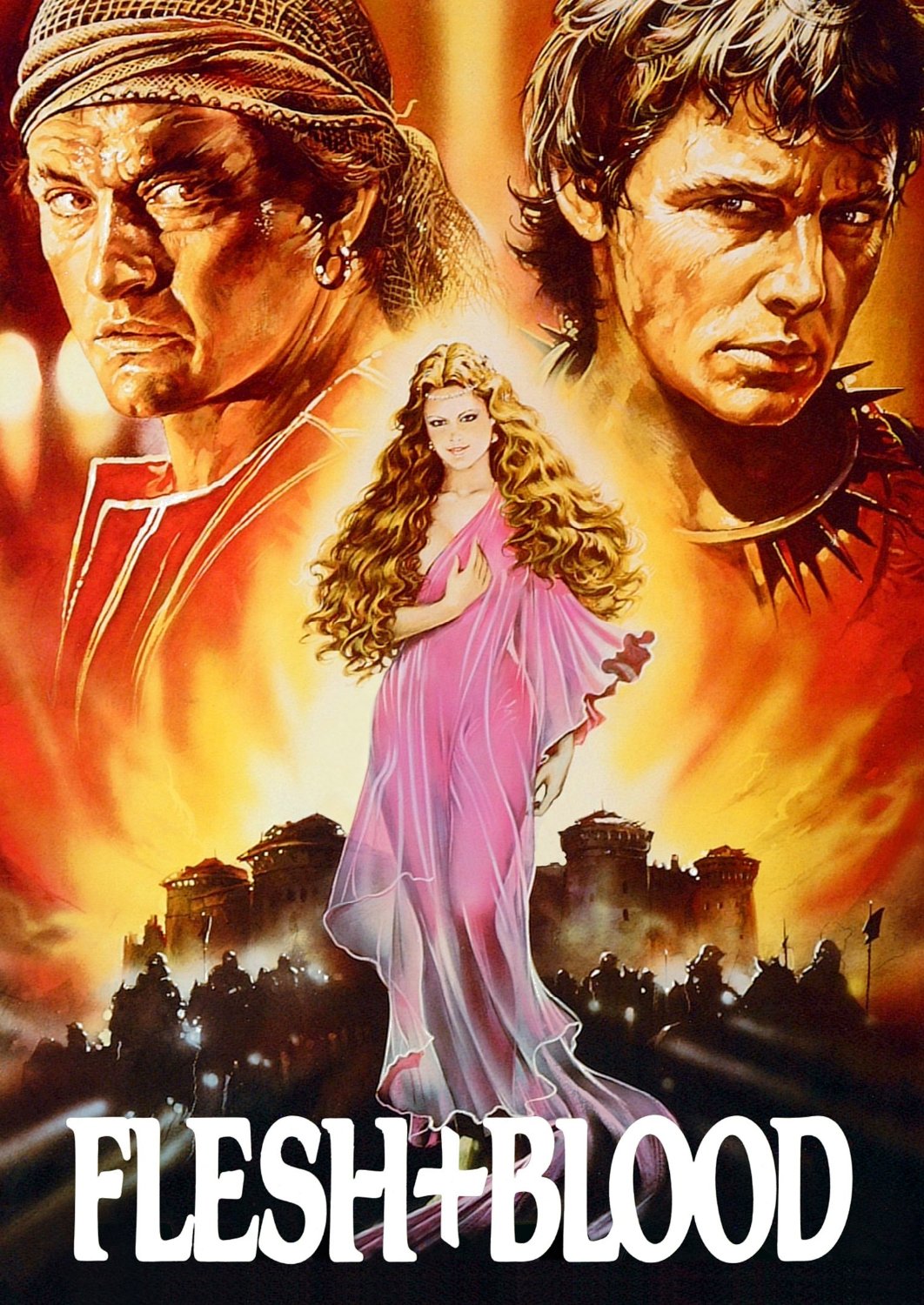
Flesh + Blood (1985)
AKA The Rose and the Sword
While talking to Senses of Cinema in 1998, pioneering French New Wave director Jacques Rivette spoke in defense of Paul Verhoeven’s Showgirls (1995) stating “It’s Verhoeven’s best American film and his most personal… It’s the American film that’s closest to his Dutch work. It has great sincerity, and the script is very honest, guileless… Like every Verhoeven film, it’s very unpleasant: it’s about surviving in a world populated by assholes, and that’s his philosophy.” Rivette was correct in the assessment that Showgirls bares the closest resemblance to Verhoeven’s Dutch films and the philosophy Rivette speaks of is present in virtually all of Verhoeven’s work. Even when he’s in a witty satirical mode ala RoboCop (1987) or Starship Troopers (1997), Verhoeven’s worldview doesn’t exactly appear to be on the sunny side with visions of the future filled with rampant crime and hyper militarism. A film like Hollow Man (2000) could also be seen as having a misanthropic streak despite the fact that Verhoeven feels it to be an impersonal work. Verhoeven’s first English language film, 1985’s Flesh + Blood is a fascinating entry in his filmograpgy. Dressed in medieval costume, the film is yet another example of Verhoeven’s unique take on the human condition, complete with many an exploitive element and while it doesn’t paint a very pretty picture, as always with Verhoeven there is an undeniable honesty amidst all the unflinching medieval brutality.
After a successful military campaign aiding nobleman Arnolfini reclaim a city from which he’d been booted, Martin (Rutger Hauer), the leader of a band of mercenaries, along with his crew of shady land pirates and wenches find themselves sold out when Arnolfini demands they return all the loot they were promised. Furious, Martin and the rest of his soldiers ambush a hunting caravan seriously wounding Arnolfini and making off with the contents of all the carriages including Agnes (Jennifer Jason Leigh), the bride-to-be of Arnolfini’s scholarly son Steven. Martin’s gang, along with Agnes soon overtake a castle a begin living like royalty, meanwhile Steven begins assembling an army and launches and attack on the castle in an attempt to avenge his father and rescue Agnes.
Despite the presence of castles and the plot devise of having a dashing young lad set out on a quest to save his beautiful maiden, those who go into Flesh + Blood expecting a happily ever after fairytale are in for a very rude awakening when confronted with Verhoeven’s particular brand of medieval butchery. With Flesh + Blood, Verhoeven dispenses with the whimsical fantasy elements prevalent in so many medieval tales preferring instead to present 1500’s Europe as a plague infested cesspool populated by cutthroats, backstabbers and rapists. Its no wonder the original posters for the film contained a caption claiming the film to be “A mirror of our time”. That’s not to say the film is without its share of exquisiteness, on the contrary. The settings and costumes are phenomenal, the battle scenes and sword play are expertly choreographed as well as a truly astonishing sequences involving the unveiling of an intricate war machine. Verhoeven also brilliantly blurs the line between good and bad early in the film which leads to one of the most interesting aspects of the film, that being the relationship that develops between Martin and Agnes which remains uncomfortably ambiguous right until the final frame of the film. Verhoeven also finds time to pepper the film with instances of odd humor thanks to the antics of Martin’s cohorts, namely the amazing Susan Tyrell as a drunken foul mouthed floozy as well as an exceptionally loony cardinal whom Verhoeven uses as a springboard for his none-to-subtle views on Christianity.
Flesh + Blood marked the fifth and final collaboration between Verhoeven and Rutger Hauer with Hauer previously appearing in Turkish Delight (1973), Katie Tippel (1975), Soldier of Orange (1977) and Spetters (1980). Although the two were constant collaborators their working relationship was apparently tumultuous as times. In fact, actor Brion James who played one of Hauer’s fellow mercenaries in Flesh + Blood described their relationship as “love/hate” during an interview for the New York City cult cable access program Media Funhouse. James also went on to describe how rough the film shoot was and admitted to arguing with Verhoeven (whom he refereed to as a “smiling demon”) everyday. Among other things, James recalls the winter in Spain where the film was shot being the coldest in 30 years as well as fearing for his life as a result of doing his own stunts with no safety harness on top of a 200 foot castle. Still though, he claims the finished product was the greatest film ever made about the 15th century. Being his first English language film with an impressive international cast, Flesh + Blood no doubt was a catalyst in Verhoeven’s eventual move to America. Even with an already impressive body of work behind him, Flesh + Blood was yet another feather in the cap for Verhoeven and a perfect stepping stone to the game changing films that Verhoeven would soon helm.
While talking to Senses of Cinema in 1998, pioneering French New Wave director Jacques Rivette spoke in defense of Paul Verhoeven’s Showgirls (1995) stating “It’s Verhoeven’s best American film and his most personal… It’s the American film that’s closest to his Dutch work. It has great sincerity, and the script is very honest, guileless… Like every Verhoeven film, it’s very unpleasant: it’s about surviving in a world populated by assholes, and that’s his philosophy.” Rivette was correct in the assessment that Showgirls bares the closest resemblance to Verhoeven’s Dutch films and the philosophy Rivette speaks of is present in virtually all of Verhoeven’s work. Even when he’s in a witty satirical mode ala RoboCop (1987) or Starship Troopers (1997), Verhoeven’s worldview doesn’t exactly appear to be on the sunny side with visions of the future filled with rampant crime and hyper militarism. A film like Hollow Man (2000) could also be seen as having a misanthropic streak despite the fact that Verhoeven feels it to be an impersonal work. Verhoeven’s first English language film, 1985’s Flesh + Blood is a fascinating entry in his filmograpgy. Dressed in medieval costume, the film is yet another example of Verhoeven’s unique take on the human condition, complete with many an exploitive element and while it doesn’t paint a very pretty picture, as always with Verhoeven there is an undeniable honesty amidst all the unflinching medieval brutality.
After a successful military campaign aiding nobleman Arnolfini reclaim a city from which he’d been booted, Martin (Rutger Hauer), the leader of a band of mercenaries, along with his crew of shady land pirates and wenches find themselves sold out when Arnolfini demands they return all the loot they were promised. Furious, Martin and the rest of his soldiers ambush a hunting caravan seriously wounding Arnolfini and making off with the contents of all the carriages including Agnes (Jennifer Jason Leigh), the bride-to-be of Arnolfini’s scholarly son Steven. Martin’s gang, along with Agnes soon overtake a castle a begin living like royalty, meanwhile Steven begins assembling an army and launches and attack on the castle in an attempt to avenge his father and rescue Agnes.
Despite the presence of castles and the plot devise of having a dashing young lad set out on a quest to save his beautiful maiden, those who go into Flesh + Blood expecting a happily ever after fairytale are in for a very rude awakening when confronted with Verhoeven’s particular brand of medieval butchery. With Flesh + Blood, Verhoeven dispenses with the whimsical fantasy elements prevalent in so many medieval tales preferring instead to present 1500’s Europe as a plague infested cesspool populated by cutthroats, backstabbers and rapists. Its no wonder the original posters for the film contained a caption claiming the film to be “A mirror of our time”. That’s not to say the film is without its share of exquisiteness, on the contrary. The settings and costumes are phenomenal, the battle scenes and sword play are expertly choreographed as well as a truly astonishing sequences involving the unveiling of an intricate war machine. Verhoeven also brilliantly blurs the line between good and bad early in the film which leads to one of the most interesting aspects of the film, that being the relationship that develops between Martin and Agnes which remains uncomfortably ambiguous right until the final frame of the film. Verhoeven also finds time to pepper the film with instances of odd humor thanks to the antics of Martin’s cohorts, namely the amazing Susan Tyrell as a drunken foul mouthed floozy as well as an exceptionally loony cardinal whom Verhoeven uses as a springboard for his none-to-subtle views on Christianity. Flesh + Blood marked the fifth and final collaboration between Verhoeven and Rutger Hauer with Hauer previously appearing in Turkish Delight (1973), Katie Tippel (1975), Soldier of Orange (1977) and Spetters (1980). Although the two were constant collaborators their working relationship was apparently tumultuous as times. In fact, actor Brion James who played one of Hauer’s fellow mercenaries in Flesh + Blood described their relationship as “love/hate” during an interview for the New York City cult cable access program Media Funhouse. James also went on to describe how rough the film shoot was and admitted to arguing with Verhoeven (whom he refereed to as a “smiling demon”) everyday. Among other things, James recalls the winter in Spain where the film was shot being the coldest in 30 years as well as fearing for his life as a result of doing his own stunts with no safety harness on top of a 200 foot castle. Still though, he claims the finished product was the greatest film ever made about the 15th century. Being his first English language film with an impressive international cast, Flesh + Blood no doubt was a catalyst in Verhoeven’s eventual move to America. Even with an already impressive body of work behind him, Flesh + Blood was yet another feather in the cap for Verhoeven and a perfect stepping stone to the game changing films that Verhoeven would soon helm.
Subscribe to:
Posts (Atom)