Monday, April 6, 2015

The Lair of the White Worm (1988)

One of the oldest legends in English folklore, the story of the Lambton Worm, or “wyrm”, a dragon like creature, is also one of the most interesting and creative. Like most folktales, the story has been told in many ways over the years with variations on several details, but the basic gist of the tale revolves around John Lambton, a rebellious youngster who skips church to go fishing and catches a strange worm like creature. Discarding it, Lambton throws the worm down a well where it eventually grows to a monstrous size and begins to wreak havoc in the surrounding areas until John Lambton returns and finally kills the worm. The story partially served as the basis for what was to be Bram Stoker’s final novel The Lair of the White Worm, published in 1911. According to some, Stoker was quite ill with syphilis while writing the book which would account for the often delirious tone of the writing and the books overall bizarreness. The perfect type of material for Ken Russell to base a film around and the perfect follow up his previous insane piece of literature inspired horror Gothic (1986), a fantastic imagining of the night the premise of Frankenstein came to Mary Shelly, The Lair of the White Worm is Russell at his most outrageous and a film that is in a class all its own within the horror genre.

While digging around a farmhouse inn operated by sisters Mary and Eve Trent, archeologist Angus Flint unearths an odd, dragon-esque skull which is soon followed by a mosaic featuring a portrait of Dionin, an ancient Pagan snake god. The site of the excavation is owned by James d'Ampton (Hugh Grant), a descendant of John d’Ampton who according to local legend killed the d’Ampton worm, a giant snake like creature who terrorized the village. Coinciding with the excavation is arrival of Lady Sylvia Marsh (Amanda Donohoe), a seasonal resident whose estate is located near the farmhouse as well as the cave which was said to be the d’Ampton worms lair. Not long after the skull and the deeply religious Eve go missing, prompting James to suspect the legend of the d’Ampton worm to be true and in some way connected to the Pagan mosaic and Lady Sylvia.

Unapologetically blasphemous, often ridiculous, always absurdly humorous and at times jarringly frightening, there’s no question about it, The Lair of the White Worm is a Russell film through and through. This film is a shining example of how to properly blend horror and humor with both elements perfectly balancing off each other resulting in one very entertaining and bizarre film, one that combines bits and pieces of the Lambton Worm legend, Stoker’s novel and Russell’s own unique personal touches. On first viewing and possibly even on subsequent viewings the film may seem incomprehensible from a narrative standpoint and indeed there is quite a bit in the plot to digest, with Russell making no attempt to avoid what may come across as randomness (including a surreal dream sequence on an airplane that seems to come out of nowhere even for Russell) however in the end the film ultimately does come full circle and the way Russell has the story play out makes the seemingly convoluted plot all the more interesting. Visually the film is ripe with Russell‘s flamboyant excessiveness including two instantly memorable hallucinations that provide a nice shock in the way Russell has them just appear out of the blue. Both feature what most would probably consider dated video effects but have an endearing quality to them and give them a standout look. The actual look of Dionin is quite effective as well containing just the right amount camp and if that weren’t enough Russell also throws in some striking vampyric snake/human hybrids!

Russell originally wanted Tilda Swinton to play the role of Lady Sylvia Marsh however according to producer Dan Ireland in a Trailers from Hell commentary after Swinton read the script she felt so insulted she wouldn’t even return Russell’s phone calls. No offence to Swinton who is a great talent but thankfully Russell met Amanda Donohoe who for all intensive purposes owns the film. Donohoe IS Lady Sylvia and simply oozes sexuality and brings the right amount of campiness to the role while also never loosing the characters sense of mystique. The film just wouldn’t have been the same without her. Donohoe would go onto to co-star in Russell’s The Rainbow (1989), a prequel to his classic Women in Love (1969). Interestingly enough, The Lair of the White Worm was a holdover film of sorts in order for Russell to get the funding for The Rainbow. The casting of Hugh Grant is almost hysterical in itself considering the kind of roles he would become famous for in the 90’s but he’s really good here, clearly in the on the joke so to speak and it’s a joke well worth being in on. While it may not be as full-on as The Devils (1971) or as visually excessive as Altered States (1980), The Lair of the White Worm is nonetheless one of Russell’s most entertaining genre entries and an unforgettable horror film in general.


Monday, March 23, 2015

L'Immortelle (1963)

Alain Robbe-Grillet found himself in an interesting position in 1963. Always quick with some self-deprecating humor, the brilliant novelist and filmmaker constantly quipped that during the 50’s and 60’s when the “nouvelle roman” or new novel movement which Robbe-Grillet was a leader, if not the inventor of, was en vogue, Robbe-Grillet’s name was one to drop, even if as he put it, nobody read him. Robbe-Grillet’s name became even famous when his screenplay for Alain Resnais’ Last Year at Marinbad (1961) was nominated for an Oscar, even though he wasn’t a best seller and French literary critics failed to comprehend his radical writing style. Robbe-Grillet had always expressed interest in making films and during a 1989 lecture at San Francisco University he joked that he was probably asked to direct films due to the popular critical consensus that his novels were films that just haven’t been made yet, citing his 1957 novel Jealousy in which over the course of 200 pages a house is described while still not really giving a clear example of what the house actually looks like so it was only right to give Robbe-Grillet a camera and literally show the house! Robbe-Grillet’s astonishing first film, 1963’s L’Immortelle was a perfect cinematic translation of his unconventional nouvelle roman writing style and set in motion what was to become one of the most fascinating, provocative and distinctive filmographies in European cinema.    

Shortly after arriving in Istanbul for work purposes, a professor meets a mysterious woman (Françoise Brion) and is immediately taken with her. The two begin a relationship although she remains enigmatic, never really letting him get to know her much to his frustration. He becomes even more perplexed when she tells him she’s going away for a few days without giving any explanation why and is adamant about not being contacted. Afterwards the man becomes obsessed and sets out on the mystifying and potentially dangerous task of finding out all he can about his elusive companion.

At one point during L’Immortelle (The Immortal One) Françoise Brion’s nameless enchanter muses to her (also nameless) suitor that the Turkey in which the film takes place is the “Turkey of your dreams”. Its a description that couldn’t have been more apt, yet at the same time could also be taken with a grain of salt with nothing in a Robbe-Grillet film being instantly explainable. The Istanbul which Robbe-Grillet presents certainly exists in the real word, the film itself however seems to be suspended between the waking and dream world. It’s a world where every character seems to be in a zombified haze of sorts, where the inhabitants speak in cryptic, oftentimes contradicting terms and events are repeated but perhaps not in the exact way they happened in the first place. Such descriptions might make L’Immortelle sound impenetrable however the opposite is true. Robbe-Grillet’s fragmented presentation is unquestionably bewildering but it is also exotic and enticing. The mood the film projects as a result of Robbe-Grillet’s direction and disjointed narrative is astounding making L’Immortelle a film that’s incredibly difficult to not get lost in. Two factors also contribute immensely to the films already trancelike ambiance. The first being Robbe-Grillet’s postcard-esque display Istanbul which essentially becomes its own character but more importantly, the arresting presence of Françoise Brion, with the spell Brion casts on the star-crossed professor carrying over to the audience as well, so much so that the film never once drags even during the portion of the film when she is absent.

L’Immortelle was awarded the Prix Louis Delluc, a prestigious French film award given out buy a jury comprised of mostly film critics, although ironically when the film was released the overall critical response was generally lukewarm or negative. While the majority of Robbe-Grillet’s films were difficult to find up until early 2014 when L’Immortelle along with Trans-Europ-Express (1967), The Man Who Lies (1968), Eden and After (1970) and Successive Slidings of Pleasure (1974) finally received remastered DVD treatments, L’Immortelle was one of the more if not the most tricky to track down unless a screening was held. Thanks to BFI who released all the aforementioned films in a box set and Kino/Redemption who released the films separately, L’Immortelle is readily available. All the discs contain interviews with Robbe-Grillet and the one conducted for L’Immortelle is one of the most interesting as he goes into great detail as to what it was like directing a film for the first time and goes into some of the mistakes he made as a first time filmmaker. It’s a fascinating conversation for an even more fascinating film and it shouldn’t even need to be said that the disc is essential. L’Immortelle is one of Robbe-Grillet’s finest films and like all debuts from major auteurs its is a special film and one that serves as a sign of things to come. A stunning debut from a true original.

Monday, March 9, 2015

Lower Level (1992)

Kristine Peterson probably isn’t a name that is familiar to a number of genre fans however from 1988 to 1997 Peterson helmed a handful of films that should be of interest to genre fans. Peterson cut her teeth working as an assistant director or second unit director on low budget cult classics like Chopping Mall (1982), The Ladies Club (1986), Reform School Girls (1986) and even bigger budget Hollywood productions such as Bill and Ted’s Excellent Adventure (1989), A Nightmare on Elm Street 5: The Dream Child (1989) and Tremors (1990). In the late 80’s Peterson began directing her own films, the first of which was Deadly Dreams (1988), a psychological slasher with far greater ambitions than other films of its ilk. Peterson followed up Deadly Dreams with the Roger Corman backed erotic thriller Body Chemistry (1990), a film that probably isn’t going to be given any awards for “best original screenplay” but is nonetheless one of the best erotic thrillers to come out of the post-Fatal Attraction (1987) craze. Peterson’s career took some pretty interesting lefts, IE Critters 3 (1991) and Kickboxer 5 (1995), but its clear that Peterson was comfortable working in genre film, namely the horror, thriller and action genres and in 1992 she blended the three masterfully with Lower Level, a brilliant low key little B-thriller that despite its title, is at a higher level than most (pun intended) .

Architect Hillary White (Elizabeth Gracen) returns to her high-tech, high rise office building after her boyfriend Craig bails on their plans for a romantic night out together. Unbeknownst to Hillary, Sam (David Bradley) the night watchman at her building has been harboring an obsession with her for the longest time and has planned a special evening of his own for Hillary and himself. Hillary however doesn’t reciprocate his feelings which sends Sam over the edge and Hillary suddenly finds herself trapped inside her office building with a psychopath who controls the entire buildings securely system and every exit.

While there is certainly a direct to video/late night cable vibe to Lower Level, considering the talent involved it shouldn’t come as a surprise that the film achieves things similar films wouldn’t even think of attempting. With a dependable director like Peterson and the flawless casting of Gracen and Bradley the film succeeds in being escapist entertainment but also a film with more on its mind than what’s advertised. Although a third player re-enters the film about midway through, this is Gracen and Bradley’s show and both steal equal parts of it. Far from being the stereotypical damsel in distress, Gracen’s Hillary is no victim. She’s a fighter, and Gracen, along with being a knockout beauty, has the presence and personality to make Hillary’s strength convincing. A more than worth opponent to Bradley’s Sam. Perhaps best known for his martial arts skills, Bradley can act and much like Hillary not being a standard genre film victim, Sam isn’t a stock ranting and raving maniac. “Sympathetic” isn’t the right word, but there is an obsessive method to Sam’s madness. Peterson doesn’t shy away from psychology, going the extra mile by acknowledging that it isn’t so much Hillary Sam is “in love” with but rather a fantasy version he’s slowly developed in his head having fetishized her for so long. Of course the other star of the film would be the office building with Peterson’s precise and slick direction wasting none of its spacious yet isolating potential including some pretty innovative moments involving elevator shafts.

After Lower Level Peterson would go on to direct only three more features, the action/caper thriller The Hard Truth (1994) which featured an impressive ensemble trio in the form of Michael Rooker, Lysette Anthony and Eric Roberts, the aforementioned, often maligned Kickboxer 5 and finally the music based drama Slaves to the Underground (1997). In between all that she also directed an episode of the CBS/USA series Silk Stalkings in 1992 as well as an episode of the Playboy series Eden in 1993. Lower Level however is easily her best and most accomplished work and although the films feature different subject matter, Lower Level would nonetheless make for great marathon viewing with Peterson’s Deadly Dreams and Body Chemistry as all three seem to occupy the same obsessive headspace. The film went direct to video and probably pay cable back in the day and the film actually did get a DVD release courtesy of First Look Features. Unfortunately that release seemed to go out of print almost as fast as the discs were pressed and as is so often the case goes for ridiculous prices. Thankfully the film is still easy to find on VHS even though it’d be a beautiful thing to see the film get a re-release on DVD as like the best of Peterson’s films Lower Level epitomizes the term “hidden gem” and deserves better than to be hidden in obscurity.


Monday, February 23, 2015

La ocasión (1978)

While José Ramón Larraz may be best remembered for his early British films which consisted of horror/thrillers like Whirlpool (1970), Deviation (1971), Scream and Die (1973), Symptoms (1974) and culminating with Vampyres (1974), Larraz’s Spanish period upon his return to Spain following the death of dictator Francisco Franco really showcased Larraz’s versatility as a director resulting in numerous films in a variety of genres and subgenres. Larraz gained a reputation in Spain for comedies such as Give Us Our Daily Sex (1979) which starred Laura Gemser, La momia nacional (The National Mummy, 1981) and Polvos mágicos (1983) which were quite successful but before that Larraz directed the marital drama El mirón (The Voyeur, 1977), the bizarre The Coming of Sin (1978) which is perhaps the best known film from this period, the spy film The Golden Lady (1979), and the erotic drama Madame Olga’s Pupils (1981). Of course Larraz never forgot about horror and films like La muerte incierta (1977) and Stigma (1980) proved just how valuable Larraz was to the genre along with the notorious satanic sexploitation classic Black Candles (1982). There were others that also proved Larraz could do it all but anyone who’s seen a handful of Larraz’s films can attest too, Larraz felt most at home with thrillers so it should come as no surprise that 1978’s La ocasión is one of the strongest films from Larraz’s Spanish period.

Husband and wife Pablo and Anna return to their beachfront home only to find it trashed after having been broken into. Pablo immediately suspects a group of young hippies that have been staying at the farm next door and is determined to get rid of them while Anna, who isn’t exactly trilled with the group also doesn’t approve of Pablo’s overly antagonistic attitude. Pablo becomes increasingly more annoyed with the group and their antics eventually reporting them to the police in hopes of finally being rid of them for good, that is until the leader of the group decides to pay him and Anna a visit.

Following films like the surreal and superstitious La muerte incierta and The Coming of Sin, La ocasión (The Occasion) really finds Larraz in his element. The film is very much in the vein of his early British films complete with shady characters, isolated locations and ambiguity, although there is an apparent lack of atmosphere which Larraz’s British films contained in abundance but in all fairness to the film this particular story doesn’t necessarily call for heavy atmospherics and what it lacks in atmosphere it more than makes up for in sheer moodiness. Larraz was always a slow story teller and La ocasión is certainly one of his more languid pieces. As always nothing is ever obvious in Larraz’s world and La ocasión is an interesting watch in that for the majority of the film there is never really any clear indication of where the film is heading. While Pablo’s issues with the hippies are obviously at the forefront, Larraz spends an equal, if not more amount of time examining Pablo and Anna’s marriage and Anna’s hints of sexual frustration as well as her slightly conflicted feelings regarding the hippies. By the time the film reaches its third act and becomes a three character piece Larraz finds a way to brilliantly blend every single plot point previously explored leading to some quintessential Larraz intensity and the direction Larraz eventually takes the film results in some fairly twisted sexual ambiguity in regards to Anna’s state of mind which Larraz wisely leaves a slightly unsettling mystery.

La ocasión has proven to be one of Larraz’s most elusive films. Hardly anything has been written about it save for one dismissive review on IMDb and its home video history seems to be a bit of a mystery as well. A quick image search will turn up a clamshell VHS cover for the film that was being sold on a Spanish auction site. The tape was released by one Constan Films, S.A. which also happened to be the films production company, yet its also been said that the film never received a VHS release, that the only available version of the film is sourced from a VHS recording of a Spanish television airing of the film. Interesting to say the least. Image searches will also reveal other items related to the film that were sold on the same auction site as that VHS tape such as the films poster, several sets of lobby cards and a press book. Over the past year or so the film did finally begin to pop up on several torrent sites but for those that still prefer to watch films the proper way there are discs out there for those that know where to look which are more than well worth seeking out and picking up as La ocasión is an intelligent and psychologically ambitious thriller and a film that’s easily recommendable to any serious Larraz fan.

Monday, February 9, 2015

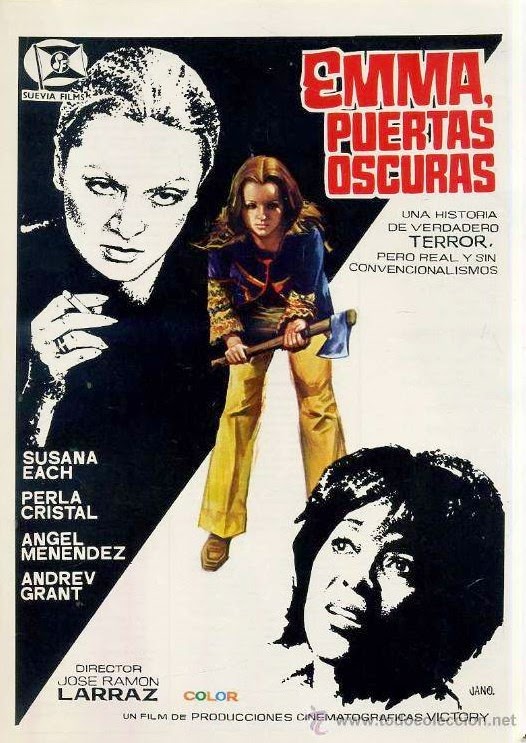
Emma, puertas oscuras (1974)

One of the most fascinating things about watching the work of a cinematic auteur is witnessing the gradual creation of a self-contained cinematic universe. Not only is it fascinating but rewarding also when the films are viewed in chronological order, being able to see the beginning of both narrative and visual motifs, said motifs being expanded on and eventually perfected, noticing how one film relates to another, things of that nature. José Ramón Larraz was one such auteur who unquestionably created a highly personal universe. Larraz is a particularly interesting case in that with his first film Whirlpool (1970) he essentially laid all his calling cards out on the table, the isolated countryside setting, shady and hedonistic characters clearly hiding some form of ulterior motive, a prevailing sense of mystery and an approach to sexuality that was both visceral and psychological. What’s incredible is that even with Whirlpool being his first film Larraz clearly had a pretty good handle on all these things and would continue to expand upon them with subsequent films like Deviation (1971), Scream and Die (1973) and Symptoms (1974) , which for all intensive purposes is the culmination of everything Larraz began with Whirlpool. Somewhat lost in the shuffle of all those films is Emma, puertas oscuras, a transitional piece that found Larraz again expanding on his obsessions while also adding some new elements making for one curious little film.

Emma, a young woman is seriously injured in a hit an run accident. Silvia, a psychiatrist who witnessed the accident gets to know Emma at the hospital where Emma is recovering and the two became very close. So close in fact that Silvia offers to become Emma’s legal guardian and adopt her upon her release from the hospital as Emma has no known family. The accident however has changed Emma, leaving her with severe abandonment issues  causing her behavior to become erratic and violent and Silvia’s threats of sending Emma back to the hospital push Emma, razor in hand, over the edge and out into the country on her own.

Sandwiched in between Scream and Die and Symptoms, Emma, puertas oscuras (Emma, Dark Doors) is the logical bridge between the two films utilizing the slasher components of the former while flirting with the psychology of the later. While the film isn’t nearly as psychologically sophisticated as Symptoms its nonetheless a precursor in the way it explores Emma’s separation anxiety and her fear of abandonment which leads to violence. The majority of the first half of the film is made up of Larraz’s focusing on the loving yet somewhat contentious relationship between Emma and Silvia and as always with Larraz nothing is ever spelled out entirely making the nature of their relationship all the more fascinating. Although its not as overt as in Symptoms there are some clear hints of lesbianism and sexual tention between the two which Larraz perverts with the fact that Silvia is technically Emma’s adopted mother. Per usual Larraz tells the story in a leisurely fashion only to give a nice jolt by way of Emma’s nasty scissor and razor attacks and a bizarre dream sequence. Its during the third act where the films slasher side takes over and where it really begins to recall Scream and Die with Emma’s survival (predatory) instincts kicking in and Larraz brilliantly setting the action in an abandoned hotel. The perfect setting for Larraz’s trademark atmospherics to make an appearance which give these moments a classical, gothic feel, a technique Larraz would return to in future films like Stigma (1980) and Deadly Manor (1990).

One of the most interesting things about Emma, puertas oscuras is that it was a Spanish production made right in the middle of Larraz’s British period. The locations and vehicles seen all throughout the film make it clear that it was shot in England, at least the overwhelming majority of it was so its interesting that the film was funded with Spanish money especially considering Larraz having left Spain years before due to censorship. Another fun fact is that two years prior lead actress Susanna East (who by the way is excellent in the titular role of Emma) appeared in Ken Russell’s Savage Messiah (1972). Larraz fanatics will no doubt instantly recognize red headed actor Andrew Grant in the role of a hippy that makes the mistake of trying to take advantage of Emma late in the film. Grant of course played Tom, Karl Lanchbury’s accomplice in rape and voyeurism in Whirlpool. Emma, puertas oscuras is another one of Larraz’s films that remained elusive for some time having been (presumably) only released on Spanish VHS until it began to pop up online in recent years much like Larraz’s La muerte incierta (1977). English subtitled discs are now out there, sourced from that Spanish VHS tape and its a film that Larraz fans would benefit from seeing as its ultimately a film that would end up becoming a fitting piece in Larraz’s cinematic puzzle.

Monday, January 26, 2015

Sexus (1965)

AKA L'enfer dans la peau (Hell in the Skin)

Ever the belligerent type, it was José Bénazéraf’s contentious attitude that led him to directing films. Bénazéraf started in the film industry in the late 50’s as a producer but began to feel that he could direct a film that was better than the ones he was producing. Despite the fact that the majority of Bénazéraf’s filmography consists of adult features having turned his attention to the hardcore market in the 70’s, Bénazéraf’s early features all feature several signature stamps setting them apart from all other films being made at the time and are near impossible to mistake for the work of any other filmmaker. These films run the gamut from the moody eroticism of his debut feature L'éternité pour nous (Eternity for Us, 1963), trangressive gangster films like Le concerto de la peur (The Concert of Fear, 1963) and 1966’s Joë Caligula (banned by the French censors, a decision which is often cited as playing one of the biggest hands in Bénazéraf eventually transitioning into adult films), espionage thrillers like L'enfer sur la plage (Hell on the Beach, 1966) and surreal unclassifiable oddities like Le désirable et le sublime (The Desirable and the Sublime, 1970). Combining the best elements of both L'éternité pour nous and Le concerto de la peur, 1965’s Sexus is not only one of Bénazéraf’s masterpieces, but its a film that epitomizes Bénazéraf’s radical early black and white period.  

Virginie, the daughter of a wealthy man is kidnapped in broad daylight by Carl and Pierre, two gangsters who plan on demanding a ransom from her father in exchange for her safe return. Not long after arriving at their chateau safe house the situation becomes tense with the arrival of a third gangster, the sadistic Francois and things become even more combustible after Carl attempts to rape Virginie, causing dissention within the group while the entire time Virginie finds herself becoming more and more attracted to Pierre.

Although Bénazéraf had already proven to have great handle on similar material as evidenced in the aforementioned L'éternité pour nous and Le concerto de la peur, Sexus (La Nuit Plus La Longue, The Longest Night) is for all intensive purposes where Bénazéraf really perfected his style. Sexus is perhaps the “purest”, for lack of a better term, of Bénazéraf’s early films as what he had explored in previous films really came to a head in Sexus. A classic example of accomplishing a lot with a little, Sexus is as minimal as a film can get yet it is also one of Bénazéraf’s most fully realized films which isn’t always the easiest thing to pull off with a film that feels as random and improvised as this does. The randomness however works very much in the films favor and only serves to heighten the tension that Bénazéraf establishes almost immediately. Sexus is perhaps the moodiest of all of Bénazéraf’s films with Bénazéraf preferring to let the actors faces set the mood rather than dialogue. What also makes Sexus a special film is its overt weirdness with characters behaving inexplicably, the twisted relationship that develops between Virginie and Pierre, an out of the blue S&M strip show and a political discussion that has nothing to do with anything. The films oddness is further pronounced by the insane free jazz score by the brilliant Chet Baker which despite contrasting greatly with the films otherwise brooding quietness couldn’t have been more appropriate for a film like this.

One of the most notable things regarding Sexus is that it was picked up for American distribution by cult film legend Radley Metzger’s Audubon Films who were responsible for renaming the film “Sexus”. Metzger, an admirer of Bénazéraf’s stated in a 1973 Film Comment interview “He really has a feel for making an erotic movie. There's a degenerate streak in his films, which he lives. You literally can smell the film. It's a gift. And he has impeccable taste in choosing his girls.” Nonetheless in the same interview Metzger admitted to cutting about 40 minutes of the film claiming “It was a style that might go today, but it seemed very slow then. We were trying to give our audience a little more commercial entertainment, so I compressed the thing, took out a lot of the pauses.” Another important thing about the film is it happens to currently be the only Bénazéraf film to have an official uncut DVD in release in North America courtesy of Video Dimensions. The DVD features two short films as extra’s, Paris Eyefuls (1958) and Strip (1965) both dealing appropriately enough with strippers. Though neither were directed by Bénazéraf they make for an interesting watches. Needless to say the DVD is a must have as Sexus is a pivotal film and required viewing for anyone interested in Bénazéraf and would make for a perfect starting place for newcomers.

Monday, January 12, 2015

Two Orphan Vampires (1997)

Jean Rollin may have made a name for himself with his highly personal take on vampires in the early to mid 70’s with films like The Rape of the Vampire (1968), The Nude Vampire (1970), The Shiver of the Vampires (1970), Requiem for a Vampire (1971) and Lips of Blood (1975) so its interesting that Rollin took an extended break from vampires after having been incensed over Lips of Blood having been meddled with and edited into an adult feature titled Suck Me Vampire. Following Lips of Blood, Rollin helmed a slew of unique films in various subgenres ranging from the slightly vampiric Fascination (1979), zombies in The Grapes of Death (1978) and The Living Dead Girl (1982), the cold, Cronenbergian Night of the Hunted (1980) and The Escapees (1981). Rollin was also a prolific writer and in the mid-1990’s began a series of five books revolving around the characters of Henriette and Louise, the two blind orphan vampires which would eventually lead to Rollin’s return to vampire films when he decided to adapt one of his own books to the screen resulting in Two Orphan Vampires the film. Despite the fact that the film was Rollin‘s first vampire film in 22 years, the film has been neglected somewhat since its release when compared to his earlier vampire films which is unfortunate as the film is one of Rollin’s purest and most poignant.

Henriette (Isabelle Teboul) and Louise (Alexandra Pic) are two blind orphans living in a church owned orphanage. What the nuns who oversee the orphanage are completely oblivious too is the fact that once night falls Henriette and Louise’s sight is restored and along with it comes a taste for blood. The two eventually leave the orphanage after being adopted by a doctor who hopes to one day cure their blindness. Once out of the orphanage, Henriette and Louise’s bloodthirst as well as their penchant for troublemaking grows and the duo’s nightly adventures become more violent and dangerous as they encounter various other creatures of the night.  

Two Orphan Vampires (Les deux orphelines vampires) is an interesting film in the sense that it essentially sees Rollin taking the style of his 70’s vampire films and transporting it into the 90’s, the main difference being the downscaling of the eroticism often found in his 70’s works. Setting that aside Two Orphan Vampires is still unquestionably a Rollin film. The pacing this time around is a little more languid even by Rollin standards and yet never once does the film become boring. In fact the leisurely pace couldn’t have been more suitable for the random nature of the film and the orphans surreal run-in’s with other fantastic creatures like a hunted she-wolf, a lonely, mournful ghoul and most memorably, the “midnight lady”, a powerful vampire-like creature sporting large bat wings, just one of many quintessentially Rollin visuals seen throughout the film and oftentimes with the screen saturated in blue as it being the color the orphans see in. The film is also one of Rollin’s most satisfying when it comes to his usual devise of having a film centered around two females with Henriette and Louise being two of the most fully realized of Rollin’s reoccurring “two girls” motif, thanks in no small part to the fantastic performances of Teboul and Pic. Its never revealed just what the relationship between Henriette and Louise is and it didn’t need to be, their sisterly devotion and beautifully poetic exchanges of dialogue is both convincing and touching ultimately making the film all the more powerful.

During this period Rollin wasn’t in the best of shape suffering from kidney disease which forced him to undergo dialysis treatments which prevented him from traveling to shoot the scenes taking place in New York City which were handled by assistant director Jean-Noël Delamarre. Another mishap taking place on the set involved Véronique Djaouti, the “midnight lady” who also doubled as the stills photographer for the film. While they may not look it on screen, the bat wings her character wore were so heavy that during filming for one of her scenes she cracked two vertebrae, although she soldiered on through the entire scene. On another somewhat negative front, composer Philippe D'Aram doesn’t look back on his soundtrack for the film too fondly referring to it as a “demo” rather than a finished film score due to the films miniscule budget which is a shame as the music is one of the films strongest attributes. Two Orphan Vampires might not be as highly regarded as Rollin’s 70’s vampire films but in the grand scheme of things it is undoubtedly one of Rollin’s most important films as not only did it mark his return to the subgenre where he found his style but in true Rollin fashion the film is a journey into the fantastique featuring two of his finest protagonists making it a film that lingers in the mind long after its over.