While there have been exceptions, for the better part of the past 20 or so years it seems as if Hollywood and American films in general have stopped caring about taking chances in terms of material, choosing to stay stagnant in a sterile CGI/green screen rut. It might seem strange that there was once a point in time however when a Hollywood film with several million dollars behind it could cause a major stir, draw the ire of the MPAA and be completely subversive. Paul Verhoeven for example had this down to a science with films like RoboCop (1987), Showgirls (1995) and Starship Troopers (1997), films infamous for their content but for their intelligence as well. William Friedkin’s notorious Cruising (1980) also immediately springs to mind. So its not entirely surprising that Ken Russell would be invited to Hollywood to make Altered States (1980), although Russell’s reputation as a result of his clashes with Paddy Chayefsky who adapted to screenplay from his own novel not only led to Chayefsky taking his name off the film, in the process Russell found himself becoming a persona non grata of sorts in Hollywood. Never one to let reputation get in the way, Russell again managed to cause a major fuss with his follow-up to Altered States, 1984’s Crimes of Passion, one of Russell’s most outrageous films and at the same time one of his most heartfelt.
Electronics salesman Bobby Grady (John Laughlin) is hired by a fashion designer to do some nighttime surveillance trailing one of his employees, Joanna Crane (Kathleen Turner) whom he believes is stealing from him. While following Joanna, a serious, no nonsense business woman by day, Bobby is shocked to learn that at night Joanna takes to the streets as China Blue, a sharp tongued prostitute willing to fulfill any fantasy. Bobby, who’s marriage to his high school sweetheart Amy is in shambles, pays Joanna, as China Blue, a personal visit and soon finds himself falling for the real Joanna, all the while Joanna is being relentlessly pursued by reverend Peter Shayne (Anthony Perkins), a psychotic preacher obsessed with “saving” her.
Crimes of Passion is a blunt as a film can be in the way it presents it ideas yet at the same time can still be a bit difficult to get a read on in that while its subject matter is incredibly heavy, this is also a Ken Russell film filled to the brim with bizarre and flamboyant moments. On a purely surface level, this is a film about sex, however deep down its really a film about fear. Bobby’s fear of admitting his marriage has lost whatever spark it may have had, Amy’s fear of admitting her lack of interest in sex and Joanna’s fear of being herself and letting anyone into her life in an intimate manner outside of her China Blue persona. Its these things which give the film its heart, particularly in the dialogue department. The discussions of sex are frank and at times awkward yet purposely so, for instance in a brilliantly performed scene between Bobby and Amy where the two are finally honest with each other for the first time in what seems like ages. On the opposite end of the spectrum would be the back and fourths between China Blue and Reverend Shayne, which are just fierce but also darkly comic and the film does have a tendency to bounce back and forth between being a serious drama, erotic thriller and absurdist comedy and the later takes over every time Perkins is on screen in one of the most hilariously deranged performance ever captured on film.
Russell would return to similar territory and controversy later in his career with Whore (1991) which in many ways could be seen as somewhat of a sequel to Crimes of Passion with its pull no punches look at the life of a streetwalker mixed with the occasional moment of Russell oddness, although nothing that comes close to the lunacy that is Perkins in Crimes of Passion. Whore also features a typically fearless performance from Theresa Russell just as Crimes of Passion features Kathleen Tuner in one of her most iconic and greatest roles, no hyperbole. Aesthetically however the films are worlds apart with Whore being no frills and shot documentary style whereas Crimes of Passion is smothered in flashy neon lighting and 80’s kitsch even featuring a random moment of classic Russell surrealism represented by a television commercial and the film is equally defined by its gloriously 80’s synth score via Rick Wakeman. Despite the controversy surrounding the film upon its original release, it would appear that the film has been somewhat forgotten about over the years especially when compared to other Russell titles like Women in Love (1969), The Devils (1971) or Tommy (1975) just to name a few. Both perverted and poignant with astounding performances from Turner and Perkins, Crimes of Passion is a quintessentially Russell experience and deserves to hailed as one of his best films and a 80’s highlight.
Popular consensus seems to dictate that the 90’s were a down time for horror following the massive boom of the 70’s and 80’s. Italian horror found itself in a particularly interesting place at the dawn of the 90’s with many fans feeling that as the 80’s drew to a close, the Italian horror industry began to decline, despite the emergence of new blood like Michele Soavi and films like Stage Fright (1987) and The Church (1989) and Gianfranco Giagni’s The Spider Labyrinth (1988). While Dario Argento remained on top in terms of popularity and box office draw, other Italian masters like Sergio Martino began to move away from horror and concentrate on TV work while others like Ruggero Deodato and Umberto Lenzi continued to make horror films going into the 90’s only to basically retire from features by the mid-90’s. Despite numerous health setbacks, Lucio Fulci stayed the course throughout the 80’s and going into the 90’s. Even though his post-New York Ripper (1982) films are often looked down upon, several of Fulci’s films from this period are nonetheless interesting and some rather personal, A Cat In the Brain (1990) immediately springs to mind. Although it wasn’t intended to be, 1991’s Door into Silence would eerily and prophetically wind up being Fulci’s final film and its an effective, low key little chiller that essentially see’s Fulci looking the inevitable right in the eyes.
After a pit stop to visit his fathers grave, real estate agent Melvin Devereux (John Savage) sets out on his return home to his wife following a business trip in New Orleans. With the main highway closed, Melvin is forced to take the back roads and along the way encounters a hearse which no matter how hard he tries is unable to pass. Melvin’s trip home soon take a turn for the unusual as he discovers a mysterious woman following him who claims to be “waiting” for him and begins to find himself in one strange situation after another. The more Melvin confronts the hearse on the road, the more obsessed he becomes with the contents of the casket inside, gradually turning his journey into a waking nightmare.
Door into Silence is often negatively compared to a feature length Twilight Zone episode and although those comparisons are dismissive of the film they're somewhat accurate in terms of the films trajectory. Much like a Twilight Zone episode, the film beings with a typical, everyday situation and gradually takes a turn for the freighting and its precisely what makes the film work as well as it does, Fulci’s turning of the mundane into something surreal. Stylistically, the film is an exercise in minimalism. There are long stretches of time in the film where seemingly nothing happens except Melvin driving, however Fulci uses these moments to really let the increasingly bizarre nature of Melvin’s day sink in. A common criticism of the film is its lack of mystery and its true that its fairly obvious where the film is headed but in a way Fulci makes it glairing apparent from the first few frames of the film. In the end, this is a film where the answer of where its heading is far less important than the way the question is asked, and Fulci poses the question in a variety of interesting ways. To his credit, Fulci also does pepper the film with instances which may make some question the films ultimate destination so its not entirely out in the open. The film was shot on location on the back roads and small towns of southern Louisiana, a place with a mystique unique unto itself making the eerie mood of the film very naturalistic.
The film was produced by Joe D’Amato’s Filmirage company who, amongst other things, also produced the infamous Troll 2 (1990) and if some of the music in the film sounds familiar its because certain pieces were lifted from Troll 2 although they’re quite effective here and surprisingly don’t clash with the phenomenal jazz music that makes up the rest of the score. Interestingly, D’Amato muse, Black Emmanuelle herself, Laura Gemser, is credited as the costume designer for the film just as she was for Troll 2. While D’Amato went on record saying the film was the best he produced, the film was barley released and where it was it was tinkered with by distributors who changed the music much to Fulci’s disappointment. The opening credits also read “Directed by H. Simon Kittay” as according to Fulci, one of the films distributors felt that Fulci wasn’t an in demand name at the time therefore nobody would want to see the film. Another fun fact, star John Savage and actress Sandi Schultz who plays the mystery women in the film were married in 1993. While Door into Silence may seem worlds apart from Fulci’s more famous horror titles, its nonetheless an interesting watch not simply because it was Fulci’s final film but also in the way it sees Fulci exploring a heavy subject that was clearly on his mind quite a bit at the time.
The mid to late 80’s going into the 90’s weren’t the easiest of times for Lucio Fulci. From 1971 to 1982 Fulci was on a serious role, with seemingly one classic after another ranging from giallos like A Lizard in a Woman’s Skin (1971) and Don’t Torture a Duckling (1972), the brilliant spaghetti western Four of the Apocalypse (1975), and of course his string of horror masterpieces Zombie (1979), City of the Living Dead (1980), The Beyond (1981), The House By the Cemetery (1981) and The New York Ripper (1982). During the mid’80’s, Fulci became seriously ill and numerous heath problems would plague him for the rest of his life and there is a prevailing opinion that just like Fulci’s health, his films from this period also began to decline. Fulci would again fall ill during the filming of Zombi 3 (1988), his intended sequel to Zombie forcing exploitation stalwart Bruno Mattei to complete the film, its disastrous reputation now legendary. 1990’s Demonia was envisioned by Fulci as a comeback film of sorts, a supernatural horror film in the vein of his early 80’s classics featuring elements of the nunsploitation subgenre. Unfortunately the film failed to connect with viewers and is often cited as being one of Fulci’s worst films. A hyperbolic statement for sure as Demonia is a much more interesting film than its critics are willing to give it credit for.
While in Sicily researching the ancient Greeks, Liza, a member of a team of archeologists finds herself drawn to an old monastery and while exploring discovers the remains of five crucified corpses. Already unwelcome by the superstitious locals, Liza faces even more hostility when inquiring about the monastery and is warned by the leader of her team to stay away. After being approached by a strange woman, Liza soon learns that the monastery was once home to five nuns who made a pact with Satan and were executed for their heresy by being crucified and burned at the stake, and Liza’s entering of the crypt has awakened their spirits who begin enacting their revenge on the current residents of the village.
If there’s one thing that’s bound to hold Demonia back in the eyes of many its that Fulci was clearly going for the same vibe found in films like City of the Living Dead and The Beyond,however the overwhelming sense of apocalypse that defined those films just isn’t present in Demonia. That’s not to say that the film is without mood. On the contrary, the film is defined by a feeling of oddness from very early on and the quintessential Fulci irrationality is ever present. Interestingly, the history of the nuns and the cursed monastery is detailed at great length yet Fulci still leaves enough room for some left over mystery. Another thing that is often mentioned as a negative is the films slow pacing with most of the “action” so to speak, involving the vengeful nuns reserved for the very end however this too works in the films favor in the sense that it plays out like a hazy, unusual sleepwalking session. The utter randomness of some of the scenarios also gives the film a feeling of surreality including a very memorable death scene involving a man being split in two halves by two trees. The films photography is also a main complaint for many, even Fulci himself claimed the film was ruined by it although the locations are stunning, particular the monastery and the interiors of the nuns crypt and Fulci adds some neat post production filtering during some dream sequences featuring Liza wandering near the monastery to hypnotizing effect.
Considering the circumstances, it’s a miracle the film was even completed at all. According to actor Grady Thomas Clarkson in an interview with horror writer Alan Jones for Eyeball, the production was bound to be a mess long before shooting began. Clarkson recounts that miscommunication was common due to none of the American actors being able to understand Fulci’s broken English and in a hilarious anecdote, Clarkson gives an example of just how low the films budget was due to the fact that the alcohol seen in the film was really ice tea and nobody was allowed to swallow it in order to avoid having to spend more money buying more tea, forcing Clarkson to ask “What sort of film are you making where you have to be fake drinking fake booze?!” In the piece Clarkson also recalls almost being killed for real during his death scene and just hammering the point home that Murphy’s law was in full effect during the shooting of the film. Still, despite all that went wrong, Demonia is far from Fulci’s worst film. Fulci fans who’ve put off seeing the film based on bad press should go in with an open mind. Let films like City of the Living Dead and The Beyond be what they are and let Demonia be what it is, which is a fun supernatural horror film with a welcome spoonful of nunsploitaion.
Both Jean Rollin and Jess Franco are often mentioned in the same breath by both fans and critics of Euro cult cinema and the connection is understandable. While there are numerous differences in the way both approached filmmaking, there are some striking similarities which make the two kindred spirits. Rollin finishing the notorious Zombie Lake (1981) after Franco had abandoned the project not withstanding. A journey through the filmographies of both Rollin and Franco sees the gradual formation of personal cinematic worlds in which both relished retreating into with both returning time and time again to similar ideas, both thematically and visually, locations, obsessions and in several cases casting the same actors. In Rollin’s case, some of the usual suspects would be the constant use of two females as protagonists, cemeteries, the Dieppe beach, childhood nostalgia and of course, vampires. Despite Rollin’s and Franco’s constant returning to similar material never did it seem redundant. No matter how familiar the subject matter seemed both always approached it from a different angle and by the time the new millennium had arrived both men’s biggest influence had essentially become themselves with each film becoming more and more self-referential. Rollin followed up his return to the vampire subgenre, Two Orphan Vampires (1997) with Fiancée of Dracula, one of Rollin’s most surreal works and a film that once again finds Rollin drawing on his past is fresh ways.
While staking out a cemetery, a vampire expert professor and his assistant Thibault witness a dwarf calling upon his vampire lover and soon after accost the dwarf and begin interrogating him about his leader. Both the dwarf and his vampire woman are “parallel” creatures, supernatural beings living in the real world under the control of Count Dracula. Isabelle, a mysterious woman being held prisoner in a convent has been promised to Dracula, a union which the professor and Thibault are attempting to stop, however they’re plan is interrupted when Isabelle escapes the convent with the help of the parallel’s. Things become more complicated when Thibault begins falling for Isabelle as he and the professor face off against more parallel creatures in their desperate attempt to stop Isabelle’s marriage to Dracula and prevent her crossing over into Dracula’s parallel realm.
As is the case with most Rollin films, narrative cohesiveness takes a backseat to the visual poetry on display, however Fiancée of Dracula (La fiancée de Dracula, The Bride of Dracula) is nonetheless one of Rollin’s busiest films in terms of plot. There are several different things going on at once and each direction taken by the story only serves to make the film all the more bewildering and nonsensical with Rollin’s random stream of consciousness storytelling ultimately having the film cast the same beguiling spell Dracula has put Isabelle under on its audience. Again, the film see’s Rollin calling upon his past films for inspiration yet never once does the film seem pastiche as all the visual references take on a different context. The most recognizable visual motif would be the use of the vampire appearing from inside a grandfather clock ala The Shiver of the Vampires (1971), however in this film Dracula uses the clock as a portal of sorts transporting himself to several different areas via the clock and its use during the films finale on Rollin’s favorite beach recalls the climax of The Nude Vampire (1970). The film also sees Rollin expanding upon what he began with Two Orphan Vampires by adding other otherworldly creatures in the mix such as witches, an ogress and Brigitte Lahaie in the role a she-wolf. Rollin also incorporates a group of mad nuns who’s antics inject a healthy dose of absurd comedy into the film which only adds to its already off-center tone.
Along with all the visual cues, Rollin also harkens back to his debut feature film The Rape of the Vampire (1968) via the one of the lines of dialogue that ended that film when Isabelle recites “I am the small boy who went to look for your scarf by the sea… Dear, dear oh dear Cordelia!” This also doubles as a reference to Gaston Leroux and Phantom of the Opera. Leroux was clearly a major influence on the film. One particular line of dialogue repeated throughout the film and in some ways could be considered the films mantra, “The presbytery has lost none of its charms nor the garden its colors” is a line from Leroux’s The Mystery of the Yellow Room and Leroux’s Queen of the Sabbath is seen when Isabelle is introduced. Exactly what it all means is left open to interpretation but the way in which Rollin incorporates these literary influences within the engagement of Dracula and Isabelle give way to another Rollin trademark, the idea of doomed romanticism. Rollin would only make two more films before his passing, the deeply personal and even more self-referential La nuit des horloges (2007) and Le masque de la Méduse (2010). Despite all the health issues that may have held him back, a film like Fiancée of Dracula is proof positive that Rollin was still more than capable of delivering a surrealist masterpiece.
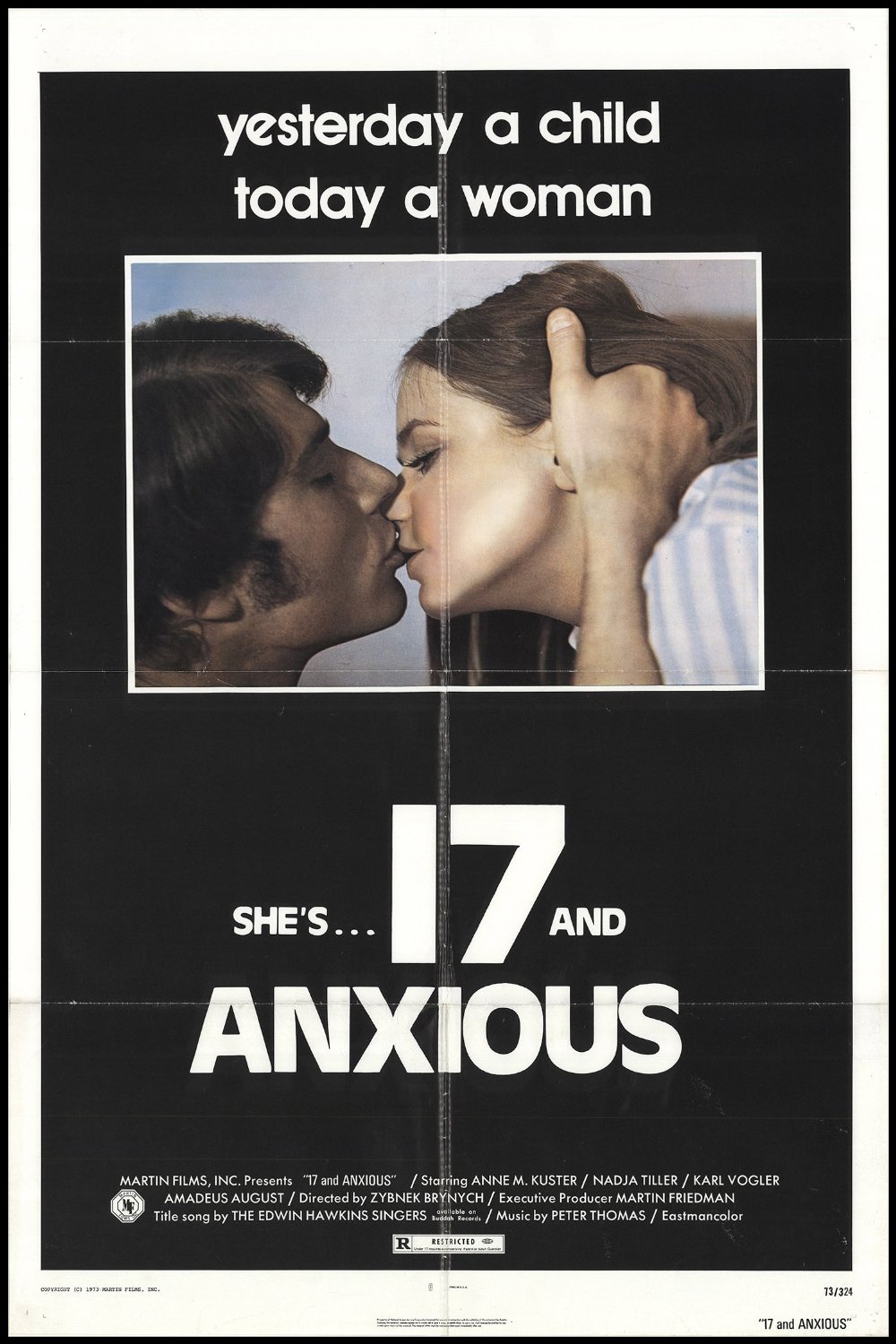
AKA 17 and Anxious, Heiße Teens aus gutem Haus and I desideri morbosi di una sedicenne
Unlike fellow Czech filmmakers such as Věra Chytilová, Miloš Forman, Jiří Menzel and Jan Němec, Zbynek Brynych sadly doesn’t seem to be a familiar name to many western aficionados of eastern European cinema. At least in America it seems, however there was a time when that might not have been the case. In 1968 when the Czech New Wave was a big deal and all the aforementioned names amongst several others became ones to drop, Brynych’s holocaust based masterpiece The Fifth Horseman is Fear (1964) made it to the States to glowing reviews. Roger Ebert even called it “a nearly perfect film”. Brynych always had a taste for the unusual and had no qualms about crossing over into genre material as evidenced by his odd Nazi sci-fi thriller I, Justice (1968) and even with its display of holocaust based real world terror, all the expressionist touches found in The Fifth Horseman is Fear do bring with them a feeling of surreality. In 1970, Brynych found himself in West Germany and while there his appreciation for films of an off center nature came to the forefront when he helmed O Happy Day, Angel’s With Burnt Wings (1970) and Femmine carnivore (1970), three of the strangest films to fall under the banner of “Euro cult” with O Happy Day having the distinction of being one of the most bizarre coming of age films ever made.
Favoring randomness over coherent storytelling, O Happy Day is essentially a plotless affair detailing the going’s on in the life of Anna (Anne-Marie Kuster), a 17 year old catholic girls school student. Despite being from a well-off family and having a seemingly good relationship with her boyfriend, Anna is dissatisfied. Like most teens her age Anna is terminally bored, feels her parents don’t understand her, is confused about what she wants out of life, full of raging hormones and just wants to be happy.
On paper it sounds like a relativity simple coming of age teen drama, however Brynych approaches the material in the most berserk manner possible, resulting in a film that’s incomparable to anything else. Anna has a habit of daydreaming as does Brynych and as a result the film has a tendency to drift in and out of fantasy without warning, leading to scenes involving dancing nuns and people cackling like maniacs for no apparent reason (something that would become a staple in Brynych’s other two German films from the same year) with Brynych’s camera going wild with delirious zooms, fish-eye lenses and constant movement to dizzying effect. The film is also overflowing with 70’s psychedelic kitsch by way of its hilariously exaggerated portrayal of hippies, select music choices and fashions on display as well as the interior design of Anna’s room, the surreal posters adorning her wall which come into play rather conveniently during one of Anna’s memorable dreams. As frivolous as the film is, it also has a fair amount of heart as Anna is a very likable and engaging character who’s easy to root for thanks to the presence and gusto performance of Anne-Marie Kuster who clearly enjoys being in front of the camera and really makes the situations Anna is going through seem more than simple and typical “nobody understands” teen nonsense. The moment when Anna spills her guts after her frustration with her parents finally boils over is very emotional and heartfelt with Kuster’s delivery coming across as genuine.
The film gets its namesake “O Happy Day” from the pop/gospel song “Oh Happy Day” by the Edwin Hawkins Singers which is heard repeatedly throughout the film and its use in the final moments of the film is quite hilarious given the context of the scene and Anna’s voiceover narration. Brynych would use a similar tactic for his next film, the equally eccentric Angels With Burnt Wings, taking the title of the film from the Peter Thomas Sound Orchestra song “Angels Who Burn Their Wings” which plays numerous times during the course of the film. The third and final film in Brynych’s German cycle and certainly the most over the top, Femmine carniovre has the distinction of being the only film from Brynych’s German cycle to have a legitimate DVD release having gotten an official Italian release. The Fifth Horseman is Fear was released on DVD from Facets while Transport From Paradise (1962), another one of Brynych’s WWII based Czech films was released on DVD by Second Run in the UK. Both O Happy Day and Angels With Burnt Wings continue to be MIA on DVD and its really a shame because if more attention were paid to these films its more than likely they’d quickly gain a fan base amongst lovers of Euro cult/trash fare. Fans of unclassifiable, offbeat 70’s cinema need to look no further than Brynych and O Happy Day.
Its interesting to think that during the heyday of the giallo in the 70’s when filmmakers like Dario Argento, Lucio Fulci, Sergio Martino and Umberto Lenzi amongst many others were defining the genre with films like The Bird With the Crystal Plumage (1970), Don’t Torture a Duckling (1972), The Strange Vice of Mrs. Wardh (1971) and Spasmo (1974) just to name a few, that Ruggero Deodato was surprisingly missing from the giallo game. Deodato’s first 70’s thriller Waves of Lust (1975) owed more to a film like Polanki’s Knife in the Water (1962) than any of the films that inspired the giallos of the day and he would follow that film with Live Like a Cop, Die Like a Man (1976), an essential title in the poliziotteschi subgenre, and of course Deodato would soon make his entry in the cannibal genre with Jungle Holocaust (1977). It wasn’t until the late 80’s when Deodato chose to helm his first giallo and the resulting film, Phantom of Death (1987), was certainly one of the more unique the genre had to offer with a strange plot combing murder with the disease progeria of all things. Deodato would return to the giallo in the early 90’s with The Washing Machine, one of his best films and one sets itself apart from other films in the genre with its bizarre eroticism, demented sense of humor and overall oddness.
Inspector Alexander Stacev is called to the home shared by sisters Ludmilla, Vida and Maria after Ludmilla claims to have discovered the body of Vida’s pimp boyfriend Yuri chopped up in the washing machine in the middle of the night. When Alexander arrives on the scene however there is no body to be found nor any evidence that a crime has even been committed. Dismissing Ludmilla’s story as a drunken hallucination, Alexander concludes that, without a body, there is no case. The sisters however see it differently and begin to follow Alexander everywhere pestering him to look into Yuri’s disappearance, eventually seducing him one by one making things quite complicated as the more he investigates the more the sisters seductive mind games suck him deeper into their strange world.
While The Washing Machine is technically an erotic mystery/thriller, in truth the film doesn’t exactly play out like a typical mystery story, at least until the third act. Its not that Deodato totally eschews the mystery of Yuri’s disappearance or the question of whether or not he disappeared at all, but that particular plot element quickly takes a backseat to the wild goose chase Alexander is led on by the three loony sisters, described by Alexander at one point during the film as “deranged”. Its an appropriate description as the situations Alexander finds himself in with each of the sisters are quite loopy, making the film come across as some sort of off-kilter psychosexual comedy. It very quickly crosses over into absurd territory featuring a scene involving an attempt at seduction via a salad bowl thrown into Alexander’s crotch and a fairly uncomfortable looking sex scene taking place against a staircase railing which Alexander is handcuffed too. There’s also the zaniness that arises as a result of each of the sisters occupations, culminating in a hilariously bizarre scene featuring Alexander and one of the sisters going at each other in a museum surrounded by blind people. Such things might make the film seem impossible to take seriously as a mystery/thriller but the matter of fact way in which it’s all presented only adds to the films strangeness and give it its own identity along with Deodato’s slick direction, the cold, blue hue that saturates nearly every frame and Claudio Simonetti’s equally icy score.
Despite the fact that again, the film is one of Deodato’s best, Deodato himself doesn’t feel that way and has gone on record expressing his disappointment with the film, specifically singling out the cast saying in the book Cannibal Holocaust: The Savage Cinema of Ruggero Deodato“I wasn't very happy with The Washing Machine because I was never convinced that the casting was correct, and the film was made too quickly… I can only say that I am not at all pleased with the final result because it's a very intimate movie and should have had well-known actors, which it does not. So, after the first few minutes it collapses.” With all due respect to Deodato, this is clearly a case of an artist being his harshest critic as the cast is actually one of the best things about the film! The three sisters especially were all perfectly cast with Barbara Ricci really standing out as the drunken Ludmilla and Dylan McDermott look-alike Philippe Caroit giving an appropriately bewildered performance as Alexander. The Washing Machine was also Deodato’s last theatrical feature until his 2016 return Ballad in Blood so here’s hoping that in time his opinion of the film changes. There’s really nothing else like The Washing Machine either in Deodato’s filmography or the realm of the erotic thriller making it an eccentric, sleazy and at times ridiculous highlight for Deodato and giallo fans.
Having a film that goes down in history as a result of becoming infamous the instant its released can be a blessing and a curse for some directors. On one hand, its nice to have a film that is sure to never be forgotten however on the other it can lead many to paint with a broad brush and expect the exact same types of films. While most hardcore Italian genre film fanatics are familiar with the entirety of Ruggero Deodato’s filmography, there are some who expect all his films to be in the vein of Cannibal Holocaust (1980) and to a lesser extent The House on the Edge of the Park (1980). Not only is that unfair to the rest of Deodato’s output but those who do so are only doing a disservice to themselves as Deodato’s body of work is incredibly versatile. Following The House on the Edge of the Park, Deodato put his stamp on a number of genres and subgenres like Body Count (1986), Deodato’s take on the summer camp slasher, the off-center giallo Phantom of Death (1987) and the erotic giallo The Washing Machine (1993). Then there’s a film like Dial: Help. Certainly one of the most bizarre Italian horror films from the 80’s, Dial: Help is also a wholly original film that is all too often put down by those who sadly can’t see past its unusualness.
While trying to call her agent, Jenny (Charlotte Lewis), an English model living in Rome accidentally dials a wrong number and soon after begins receiving phone calls with nothing on the other line but strange noises and unfamiliar voices calling out her name. Even after getting a new phone the calls continue and soon Jenny’s friends begin getting murdered and Jenny finds herself in psychical danger. Jenny discovers that she is being pursued by phantoms whom have taken possession of the telephone lines, and with the help of her new neighbor Riccardo sets out to uncover the reasoning behind what is happening to her in order to save herself.
Along with its outlandish storyline, Dial: Help is also unique when compared to the rest of Deodato’s body of work on account of it being one of Deodato’s most fantasy and supernaturally based films. At first glance a film with this type of story is probably a bit difficult to take completely seriously, however Deodato does indeed handle the majority of the film with a straight face which actually works in the films favor making it all the more beguiling. As loopy as it is, the source of the haunted phone lines and Jenny’s ensuing investigation is rather intriguing and the film moves at a brisk pace helped immensely by the presence of Charlotte Lewis who, like Deodato, seems fully committed to the material no matter how odd it gets (doing a striptease for a phone while in a trance for example) and the relationship that develops between Jenny and Riccardo throughout the film is quite sweet. Visually the film is incredibly slick with Deodato’s precise camera movements and the production design, making the film an interesting time capsule with the interior of Jenny’s apartment being a snap-shot of late 80’s chic and there are some pretty interesting looking telephones on display as well. The films premise also gives way to some very innovative set pieces, all involving telephones of course, the highlights being a possessed pay phone spitting coins out at high speed, Lewis being strung upside down by a phone cord and in a fairly fetishistic scene, bound by magnetic tape.
The film also features a score by legendary Italian genre film composer Claudio Simonetti. It was Simonetti’s second time working with Deodato having previously done the scores for Cut and Run (1985) and Body Count. Simonetti would also provide the music for The Washing Machine. Per usual with Simonetti the music is excellent, much like the look of the film the sound is also very much “of its time”, very 80’s electronic and synth based yet entirely appropriate considering the films chic aesthetic. At one point during the possessed pay phone scene the music even resembles electronic punk rock. Its worth noting that that Charlotte Lewis kept a fairly high profile around this time having appeared in the Eddie Murphy comedy The Golden Child (1986) two years before taking the lead in Dial: Help so this was a pretty interesting role to take at this point in her career. Her first role was in Roman Polanski’s swashbuckling epic Pirates (1986). These days, Dial: Help doesn’t seem to get much mention save for the occasional (mostly negative) review here and there, however those fed up with the constant stream of unoriginal hackwork’s currently plaguing horror should find Dial: Help to be a fun and refreshing watch. It might not contain the savage nihilism that defined some of Deodato’s other films, but for an original film ripe with off the wall ideas, look no further.