Monday, April 4, 2016

Black Demons (1991)

AKA Dèmoni 3 (Demons 3)

The world of European genre and cult film can be a bit confusing at times to someone who’s just getting into these types of films in that many films have been released under multiple (oftentimes absurd) titles and in some cases renamed to be marketed as sequels to films with which there is no connection. The Italians are particularly good at this with probably the most famous example being Lucio Fulci’s Zombie (1979) being released as Zombi 2 selling it as sequel to Dawn of the Dead (1978). Umberto Lenzi has suffered at the hands of the re-title several times which has led to some confusion. His first collaboration with Carroll Baker, Orgasmo (1969), was later released as Paranoia while his next film with Baker, A Quiet Place to Kill (1970) was originally titled Paranoia, not to be confused with Oasis of Fear (1971) which is also known as An Ideal Place to Kill along with Dirty Pictures! Lenzi’s 1991 voodoo/zombie film Black Demons can also be added to the list of films released as sequels as it was marketed as the third film in the Demons series. Black Demons might not have anything to do with Lamberto Bava’s first two Demons films, but it is however a wholly original take on zombies and an excellent Italian horror film from a time where most had all but declared the Italian horror industry dead.

While vacationing in Brazil with his sister Jessica and her boyfriend Kevin, Dick, an American tourist, attends a voodoo ceremony where he becomes overtaken by a powerful evil macumba spirit. The following day, their jeep breaks down in the middle of nowhere where two locals happen upon them and invite them to stay at the property they’re renting nearby. That night while wandering the property in a trance, Dick stumbles upon an old graveyard. Compelled by the spirit that's taken possession of him, Dick plays the tape recording of the chants he recorded at the ceremony, resurrecting the bodies of six slaves who were executed years ago as punishment for trying to escape the property and begin exacting their revenge on the current inhabitants.  

Black Demons is the best of both worlds when it comes to zombie films. On one hand there’s the standard “back from the dead” zombies yet on the other there’s the element of voodoo which is of course where the origin of zombie mythos is rooted as seen in films like I Walked With a Zombie (1943) and The Serpent and the Rainbow (1988). The addition of a possession angle is a bonus in an already ripe subgenre smorgasbord. The possession aspect of the film is interesting in that for the most part Lenzi keeps it on the sidelines, having it come in at just the right moments while at the same time never letting the audience forget the spell that Dick is under. It works well when coupled with the voodoo while still making sense within the context of a zombie film. Naturally Lenzi keeps certain things regarding the possession a bit ambiguous particularly as it relates to the zombies but the lack of explanation was wise as irrationality always works best when dealing with the supernatural. The film benefited greatly from being shot on location in Brazil and from a strictly visual standpoint the film is one of Lenzi’s best with the setting and surrounding areas being perfect for such a story and as with all things voodoo related there is a strange ambiance to the area. The zombies themselves look fantastic and are quite striking when filmed in the right light and are responsible for some fairly memorable death sequences.  

Lenzi was clearly unhappy with the change of titles saying “This is really awful. Its absurd. I have never seen Bava’s films and in any case his are set in a different cinema milieu. This film of mine was entitled Dèmoni 3 by a producer who was trying to exploit the title. Clearly my film has nothing in common with Lamberto Bava’s films…” Lenzi was also disappointed in the way the final film turned out as the shoot was anything but smooth. According to Lezni neither of the actors got along and the actress who plays Jessica was a last minute replacement whom Lenzi didn’t get along with at all (he also claims she was unattractive and too short for the role) and later got seriously ill after drinking unpasteurized milk and was hospitalized which disrupted the production. Hilariously, one of her doctors suspected that she could have AIDS of all things. The acting is one of the things the film gets criticized the most for so perhaps all the tension between the cast affected the film. While they might not be the most experienced of thespians they’re hardly the worst. So while it might not have turned out like Lenzi had happed, Black Demons is nonetheless a highly enjoyable 90’s Italian horror film and considering the overvaluation of bland zombie fare in recent times, should be considered a breath of fresh air.


Monday, March 21, 2016

Moebius (2013)

Never underestimate Kim Ki-duk’s ability to get himself into trouble. Along with being one of the most consistently interesting filmmakers working today, one of the things that makes Kim such a fascinating character as well as a true maverick is the polarizing reactions to his films worldwide with many of his films getting excellent reactions at various festivals, some even winning major prizes while at the same time his films and the man himself have been equally vilified. The release of The Isle (2000) was delayed in England on account of animal violence and there were many reports of audience members either fainting or vomiting during screenings. The films instances of sexual violence also led critics to deride the film and Kim. Bad Guy (2001) angered many and even led some to label Kim as misogynist and morally reprehensible and Kim was also criticized heavily for his portrayal of teenage prostitution in Samaritan Girl (2004). A hefty amount of the negativity thrown towards Kim’s films has come from his home country of South Korea with Kim being very vocal about Korean society’s attitudes towards many of the ideas explored in his films so its no surprise that 2013’s Moebius irritated the Korean censors more than ever and turned out to be Kim’s most notorious film yet as well as one of his best and one of the most audacious films of the modern era.

In an attempt to get revenge on her adulterous husband, a scorned wife and mother attempts to castrate the husband although he manages to stop her, causing her to turn her attention to the son, successfully castrating him in his sleep before disappearing. Overcome with guilt, the father goes through with a strange act of penance while the son begins an odd relationship with his fathers former mistress before the mother suddenly returns causing things to go from bad to worse.

Not even the most thorough and detailed description of every frame of Moebius (Moebiuseu, 뫼비우스) could do the film justice. This is Kim at his most fierce and full-on since the days of The Isle, Real Fiction (2000) and Bad Guy. Moebius is a brash, perverse and morbidly humorous look into the home life of the most dysfunctional cinematic family unit this side of William Fridkin’s Killer Joe (2012). As minimal as the film is in execution, thematically there is quite a bit going on. While the film may center around the nameless family, Kim also throws in elements involving a local gang the son gets involved with which leads to the relationship with the former mistress and the castration angle gives way to a side plot featuring several characters finding ways to achieve orgasm though pain. Even with all the castration, rape and incest on display, the film could ultimately be seen as a black comedy as there is a surreal absurdity to it all, from the slapstick nature of the psychical altercations between the father and the mother to the matter of fact way characters scratch themselves with rocks or have knives plunged into their shoulders for sexual gratification. The film is also one of Kim’s most experimental in that not one word of dialogue is spoken in the entire film and really none is needed. The faces of the actors say it all, particularly that of actress Lee Eun-Woo in a brilliant duel role as both the mother and mistress.

Kim essentially went “gorilla” with Moebius, shooting on very low budget on a tight schedule and operating the film himself. Interestingly, there was dialogue written for the film although Kim eventually found it unnecessary. Kim had utilized silence before to great effect, most notably in The Isle and 3-Iron (2004) so its interesting why he waited so long to do a film that was completely dialogue free. No matter as the experiment worked. Needless to say, Kim didn’t have the easiest time getting domestic distribution for the film in South Korea where the ratings board gave it a “restricted” rating, meaning it could only play in specialty theatres. The problem being that no such theatres exist in South Korea meaning the film was basically banned, resulting in Kim having to make several cuts. Lead actress Lee Eun-Woo has stated how she witnessed first hand how the reaction to Kim’s films in South Korea is world’s apart from how well his films are received internationally, recalling watching Moebius at the Venice International Film Festival where the audience got it and found the humor in the film versus watching the film with a Korean audience that was gasping in horror the entire time. With a film like Moebius, both seem appropriate but love it or hate it, the fact remains that Moebius is yet another example of Kim’s ability to provoke while being completely original.


Monday, March 7, 2016

Time (2006)

While promoting The Isle (2000), Kim Ki-duk was asked by an interviewer if he’d ever seen Takashi Miike’s Audition (1999). Kim’s response was “I saw Audition at Toronto and that movie made me realize that there is someone else out there like me. We are two of a kind.” Much like Miike, Kim has a very peculiar way of dealing with human relationships, particularly romantic ones. The romance in Kim’s films is often between two damaged souls and have either troubling beginnings and endings. For Kim’s characters, emotions that relate to love are like nerve endings. When exposed and irritated the response is extremely painful and reactions can be downright primal. In that sense Kim could also be compared to Andrzej Zulawski, although where Zulawski’s characters shriek and are almost constantly hyperactive, Kim’s are defined by their silence, with their occasional outbursts of extreme behavior doing the talking for them as evidenced in films like The Isle, Bad Guy (2001) and Moebius (2013). Despite the oftentimes dark nature of the romances found in Kim’s films, all of Kim’s films are made with heart which can sometimes make the films all the more divisive. Kim’s 2006 film Time is a quintessential Kim love story and a crown jewel in Kim’s filmography, working as both a twisted tale of jealousy and identity but also doubling as a rather biting statement on superficially in Korean culture.

Ji-woo and Seh-hee have been in a loving relationship for two years. Although he has never been unfaithful, Ji-woo has a wandering eye and Seh-hee is the extremely jealous type. Thinking that after two years Ji-woo is sick of seeing her face, Seh-hee decides to put herself through extensive plastic surgery, making her completely unrecognizable and disappearing from Ji-woo’s life without saying a word. Six months later, Seh-hee re-enters Ji-woo’s life with a different face and a new name, See-hee. The two begin dating (again) and Seh-hee’s plan seems to have worked as the new relationship has the spark of when they first met, however Ji-woo isn’t entirely over the old Seh-hee, causing her intense jealousy to re-appear as she finds herself competing with Ji-woo’s memory of her old self, forcing her to admit that she and See-hee are one and the same forcing Ji-woo to make a desperate decision of his own.

Parallels are often drawn between Time (Shi gan, 시간) and Hitchcock's Vertigo (1958) which are apt in that both films feature protagonists consumed by obsession as a result of chasing ghosts however Kim expands on the idea by having a female character with a ghost of their own which Kim takes even further by having said ghost be themselves, or rather someone else's memory of their previous identity. As is the case with many of Kim's films, there is a great feeling of sadness that hovers around Time. Not just in the sense of Ji-woo's desperation following Seh-hee’s departure or even the crippling jealousy that consumes Seh-hee but rather knowing full well that the relationship that develops between Ji-woo and the “new” See-hee can only lead to more pain for both. One of the things that makes Time such a success is Kim’s ability to present the beginning stages of the fresh romance between Ji-woo and See-hee in such a light fashion with several legitimately sweet scenes such as the new couple spending the day at a park filled with surreal sculptures, just one of many examples of Kim’s meticulously composed imagery seen throughout the film. In Kim’s world however, there is always a lingering darkness and even these tender moments have a slightly morose bend to them. What’s also incredible is Kim’s ability to make the thoroughly disturbed Seh-hee a somewhat sympathetic character during the film’s third act, a testament to the incredible and at times unhinged performance of actress Hyeon-a Seong.

Again, Time could also be read as Kim commenting on an aspect of Korean society he feels problematic, in this case plastic surgery which is massive in South Korea. In fact, South Korea is nicknamed the plastic surgery capitol of the world and according to a 2012 CNN article, the business is only going to keep growing with tourists traveling to Korea specifically for plastic surgery. There are even hotels which partner with clinics giving travelers special package deals. Kim’s particular brand of social commentary hasn’t exactly done him any favors in his home country, with Kim releasing a particularly hilarious statement addressing his critics, “... I apologize for making the public watch my films under the pretext of the difficult situation of independent cinema, and I apologize for exaggerating hideous and dark aspects of Korean society and insulting excellent Korean filmmakers with my works that ape arthouse cinema but are, in fact, but self-tortured pieces of masturbations, or maybe they're just garbage. Now I realize I am seriously mentally-challenged and inadequate for life in Korea.” What’s certainly not inadequate are Kim’s films with Time being one of his very best not to mention having one of the most original storylines while at the same time being visually and emotionally stunning . Time is a film with something to say and says it in a way that only Kim could. A modern masterpiece.


Monday, February 22, 2016

My Nights Are More Beautiful Than Your Days (1989)

Given his notoriety for histrionics, hyperactive characters and at times delving into the realm of the fantastique, its probably easy for those unfamiliar with the films of Andrzej Zulawski to simply dismiss Zulawski as a hyperbolic fantasist out of touch with reality when in fact the opposite is true. Zulawski was one of the most “human” filmmakers in the sense that the exaggerations on display in his films stripped away all pretense when it comes to human emotions, presenting them in their most exposed and raw form. Perhaps better than any other filmmaker, Zulawski understood both sites of the coin when it came to love being something than can invoke extreme reactions in individuals from the most beautiful of highs but also the most debilitating lows which leads to the behavior seen in many of Zulawski’s films. While Possession (1981) may be Zulawski’s most celebrated treatment of the anxieties relationships can cause, the idea of overwhelming emotions was a constant in Zulawski’s work going all the way back to his debut film The Third Part of the Night (1971) and the theme weighs heavily on films like L'important c'est d'aimer (1975), L’amour braque (1985) and Fidelity (2000). The exquisitely titled My Nights Are More Beautiful Than You Days is yet another one of Zulawski’s treatments on love and pain and one of his most poignant and in typical Zulawski fashion, emotionally draining films.

After finalizing a revolutionary computer language program, Lucas (Jacques Dutronc) a brilliant inventor is dealt a heavy blow by being diagnosed with a rare brain disease that will gradually erase Lucas’s memory and his ability to speak. Soon after, Lucas by chance meets Blanche (Sophie Marceau), a psychic medium in a traveling show. Although awkward at first, the two form a connection and Lucas follows Blanche to her next performance. Lucas reserves a lavish suite at a nearby seaside hotel where Blanche retreats to as a means of escape from her demanding entourage, including her husband and mother, and the two begin a fierce romance, bonded by past traumas, language and inevitable madness.

When compared to the likes of Diabel (1972), L’amour braque or Szamanka (1996), My Nights Are More Beautiful Than Your Days (Mes nuits sont plus belles que vos jours) is certainly one of Zulawski’s more “calm” efforts while at the same time still being an exhausting whirlwind of emotions that’s equally bewildering as it is beguiling. For the central romance, Zulawski strikes a perfect balance between sweetness and melancholy, with the scenes of Lucas and Blanche being tender and loving yet always shrouded by the dark cloud of inevitability, be it Lucas’s impending insanity or Blanche’s constantly being haunted by traumatic memories. Zulawski takes Lucas’s condition and the concept of madness in a fascinating direction by essentially having Lucas go mad on his own terms, willingly beating his illness to the punch. This leaves a good portion of the film, particularly the final third, open to interpretation as to whether or not what is being seen is reality or Lucas’s shattered version of reality, either by his own doing or his diseases. The madness angle also allows Zulawski’s surrealist tendencies to come to the forefront which includes the likes of a dwarf hotel porter who may or may not be a ghost and a man in a giant blue rabbit costume. Being a Zulawski film, there’s also the cast of loony side characters, mostly Blanche’s gang of hangers-on who’s antics give way to several hilarious moments and Blanche’s stage show is rather bizarre in itself with her audience interactions also being quite humorous.

While being interviewed for Eyeball, Zulawski expounded upon the importance of language and his having Lucas desperately cling to his loosening grasp of language by engaging in bizarre wordplay, either by himself or with Blanche, spouting nonsense at random and at times even speaking in rhyme, stating “With Mes nuits and Dutronic, I did it because I was really shocked by the fact that most of the films that are meant to be intelligent that I see are blah-blah films. Nothing happens, they talk. So I wanted to push this up to an absurd point, in which even the talk dissolves into a nightmare… of nonreason, whatever… and of cinema, of real cinema. Because for cinema, language or literature is only a go-between. Between the money and the screen.” Its also worth mentioning that My Nights was Zulawski’s second film to feature Sophie Marceau who made her Zulawski debut with L’amour braque and following My Nights would go on to feature in La note bleue (1991) and Fidelity. “I understand. Love means pain, lots of pain” says Marceau in one of the films most affecting moments. Its Zulawski’s understanding of that very concept and his ability to explore it in an entirely singular manner along with infusing it with moments of quirkiness and occasional off-center humor make My Nights Are More Beautiful Than Your Days a film more poignant and cathartic than most.

"Whisper everybody can - go and shriek!" R.I.P. Andrzej Zulawski (1940-2016)

Monday, February 8, 2016

Body Snatchers (1993)

Although it hasn’t been adapted to the screen nearly as much as say Frankenstein or Dracula, Jack Finney’s 1955 novel The Body Snatchers has nonetheless gone on to become one of the most iconic stories in science fiction and horror. To date there have been four film adaptations of the novel, each with their own individual flavors, although the flavor of the fourth version, The Invasion (2007) left a bitter taste in the mouths of many. Invasion of the Body Snatchers (1956), the first film based on the book directed by Don Sigel is largely considered one of the greatest and most important sci-fi films ever made and the 1978 version directed by Philip Kaufman is again considered of the best films in the sci-fi and horror genres and is just as and may even be more respected than the 1956 version. Lost in the shuffle is third adaptation made in the 1993 and its this version which is unquestionably the most undervalued and definitely the most curious as it was directed by Abel Ferrara. Simply titled Body Snatchers, the film is certainly an oddity in Ferrara’s filmography as it was a major studio production with a massive budget behind it. Body Snatchers is unique amongst Ferrara’s other ventures in the horror genre and an excellent example of the 90’s having produced more quality genre fare than said decade is given credit for.

EPA scientist Steve Malone along with his second wife Carol (Meg Tilly), daughter Marti (Gabrielle Anwar) and son Andy are sent to live on a military base while Steve gathers information regarding the effects of chemicals stored on the base. Already upset with the move, Marti soon begins to notice the strange and distant behavior of many on the base and experiences first hand the danger she and her family are in when she is awakened by an alien being attempting to attach itself to her body. Immediately Marti realizes her experience wasn’t an isolated incident as the base is slowly being taken over by aliens harvested from pods who attach themselves to a sleeping human host which it replicates and their numbers are growing at an alarming rate leaving Marti and the select few humans left fighting to retain their humanity.

Body Snatchers is proof positive that great things are possible when a studio (despite interference) is willing to give an artist with actual ideas a large budget to work with. By the time the film was made even those who may not have read the book or seen either of the previous adaptations were probably aware of the general idea of the story but Ferrara presents a completely fresh take on the “pod people”. One of the wisest moves was the military base setting. While the idea of the replicas being a metaphor for the conformity of the military might not seem all that subversive, by having the invasion take place in an already fairly insular community only added to the paranoia that easily arises with such a story. Ferrara establishes this paranoia early on with a general tone of strangeness and mistrust with the zombie-like behavior and glossed over looks of those already taken over. This uneasiness also brilliantly bleeds into the fractured family subplot leading to a fantastic performance from Anwar and an exceptionally creepy turn from Tilly. The films enormous budget clearly wasn’t wasted as the film is one of Ferrara’s strongest both technically and visually from the astonishing nighttime exteriors of the alien pods being harvested from the water and the squirm inducing, almost Cronenbergian replication sequences. Sonically too the film is top-notch with the ear-shattering scream let out by the aliens used to identify those unlike them is sure to give any sound system a proper work out.

The film has a fascinating production history being in developmental hell for years with names like Stuart Gordon and Larry Cohen originally attached before Ferrara finally got the job. Gordon actually received a screenwriting credit in the final film. Ferrara insists that the film was a technical nightmare to shoot citing the films large budget, complicated lighting schemes and the sheer size of the production in general plus instances of studio interference. After throwing outrageous amounts of money at the film and quite a bit of press coverage in various genre magazines for several years when the project was still in its infancy and even a showing at the Cannes Film Festival, Warner Bros. essentially buried the film, only releasing it in a handful of theatres in America and in some cases after the film had already hit home video. Over the years the film has remained somewhat neglected although it does have is supporters rightfully singing its praises. Surprisingly, even Roger Ebert loved the film giving it his highest rating. Obviously when compared to Ferrara’s other genre films, Body Snatchers is worlds removed from the likes of The Driller Killer (1979), Ms. 45 (1981) and The Addiction (1995) but its nonetheless a wonderfully executed horror/sci-fi film with brilliant visual style and plenty of subtext along with being one of the most original takes on Finney’s novel ultimately making it a refreshing watch.


Monday, January 25, 2016

Pelts (2006)

Looking back on Showtime’s Masters of Horror anthology series, the show was really the first of its kind. While the concept of genre anthology television shows had been around since the 50’s, Masters of Horror was the first horror anthology show where almost every episode was directed by, as the title of the show implied, a veteran of the horror genre. The series first season reads like a who’s who of well-respected genre stalwarts like John Carpenter, Dario Argneto, Tobe Hooper, Joe Dante, John Landis, Stuart Gordon, Larry Cohen and Takashi Miike (despite his episode Imprint (2006) , which was intended to be the season one finale being banned from broadcast in America) amongst others. While some of the episodes had a tendency to be hit or miss, the good ones were really good, some even great and along with Gordon’s Dreams in the Witch House (2005) and Miike’s Imprint, Argento’s Jenifer (2005) was undoubtedly one of the best, not to mention unusual episodes of the first season and an interesting stylistic detour for Argento. Several of the directors from the first season returned for the second including Carpenter, Hooper, Landis, Dante and Gordon. Argento too retuned to helm a second episode and just like Jenifer, the resulting film, the equally strange and blood-soaked Pelts was easily the biggest highlight of the second season as well as a highlight in Argento’s more recent catalogue.

Fur trader Jake Feldman (Meat Loaf) has only one desire, Shanna, a stripper whom he’s long been obsessed with. While watching Shanna dance one night, Jake gets a call from Jeb Jameson (John Saxon), a local fur trapper who claims he’s in possession of raccoon pelts that will make Jake a rich man. The pelts are indeed special as Jake soon discovers when arriving at Jebs house but he also discovers the dead bodies of Jeb and his son, an omen which Jake chooses to ignore as the pelts are cursed causing anyone who comes into contact with them to lose their minds. Jake plans on making a coat out of the pelts and proposes to Shanna that she wear it in a fashion show hoping to finally get what he wants, albeit at the price of his own skin.

Whereas Jenifer, Argento’s previous entry in the Masters of Horror series, was somewhat atypical for Argento in terms of subject matter and direction, Pelts has Argento’s fingerprints all over it from its grotesque, almost fairytale-esque storyline to its stylish visual design. It becomes apparent early on that Pelts is going to be a bizarre little film with the main plot device being cursed raccoon pelts driving people to commit horrific acts, and indeed it is rather outlandish, even absurd in spots especially when it comes too the origin of the raccoons and the history of a mysterious “ancient city”, yet Argento plays the film mostly straight which was a wise move as the films tone fits with the side themes of greed and obsession. Being made for TV the film only runs a brief 59 minutes but gets a lot accomplished in that short time frame and despite the fact that a logic is given for all the bloodshed that happens as a result of the pelts, the actual reasoning is again so odd that no mystique is ever sacrificed. What also makes the film so transfixing is Argento’s matter of fact presentation of the violence which is elaborate as it is unflinching. Faces are ripped apart inside animal traps, eyes, nostrils and mouths are sewn shut and sharp objects are taken to flesh culminating in an astonishing gore set-piece involving the magnetic Meat Loaf, who’s excellent by the way, in the role of the love to hate Jake, and his own “pelts”.

Considering the themes of selfish people getting their comeuppance working in the fur industry, Pelts could be interpreted as an attack on the fur industry however Argento claims that his intentions while making the film weren’t motivated be morals or politics but rather the idea that, despite the bizarreness of the plot, the story was as Argento puts it, a “classic” horror tale. What was intentional was the slick lighting as Argento wanted the film to be a display of colors and there’s little to no question as to who is behind the camera here. While obviously done on a much smaller scale than say Suspiria (1977) or Inferno (1980), Argento’s mastery of the color palate is ever present. Pelts also marked the first time John Saxon appeared in an Argento film since Tenebre (1982) and although his role is small Saxon is always a welcome addition to any film. Pelts was Argento’s last bit of TV work before returning to the big screen with the often misunderstood Mother of Tears (2007) and his two stints on Masters of Horror certainly do make for interesting additions to his filmography. Pelts is over the top, gruesome and at times sexy, but most importantly its an original piece of horror that showcases Argento’s knack for outlandish material and should serve as a breath of fresh air for those fed up with current bland genre offerings.


Monday, January 11, 2016

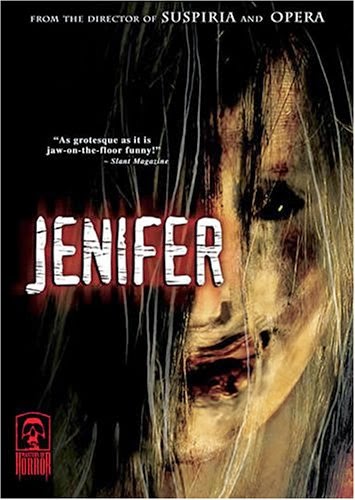
Jenifer (2005)

It seems that all the great Italian genre filmmakers eventually turn to television at some point. The last film Mario Bava worked on was a TV project entitled The Venus of Ille (1979), a tag-team effort between Bava and son Lamberto who of course also found himself at the helm of many a TV movie in the 80’s. Ruggero Deodato began his career making commercials and continued to do so throughout his filmmaking career. In 1989 Lucio Fulci and Umberto Lenzi teamed up for the House of Doom series with Fulci directing two made for TV films for the series, The Sweet House of Horrors and The House of Clocks, and Lenzi directing the other two, The House of Lost Souls and The House of Witchcraft. For the most part Sergio Martino has worked almost exclusively in television since the early 90’s, even directing the giallo mini-series Private Crimes (1993). Perhaps due to his legacy (and no doubt box office dependability in Italy), Dario Argento has managed to remain active in theatrical features although in 2005 he too took the TV route. That year not only saw Argento direct the TV movie homage to Hitchcock appropriately entitled Do You Like Hitchcock? but also Argento’s entry in the first season of Showtime’s Masters of Horror series Jenifer, one of the highlights of the first season and one of Argento’s most atypical and perverse films.

While witnessing a deranged man attempting to butcher a defenseless woman (Carrie Anne Fleming), detective Frank Spivey (Steven Weber) has no choice but to shoot the man dead. He discovers the woman’s face to be horribly disfigured and that almost nothing is known about her other than her name being Jenifer. Soon Frank is unable to get Jenifer out of his thoughts and feeling guilty about her having no place to go, Frank takes Jenifer home with him, much to the horror of his wife and son who quickly leave after discovering Jenifer’s barbaric side. Frank soon discovers another side of Jenifer, that she is a nymphomaniac with an insatiable sexual desire that he is unable to deny. Completely under Jenifer’s spell, Frank retreats to a cabin in the woods with Jenifer in a new town, a decision that can only end in disaster.

Going back and forth between being disgusting, erotic and hilarious and at times all three at once, Jenifer, both the film and the titular character are definitely oddities. Running at a rather brief 58 minutes, the film wastes little to no time getting down to business in terms of Jenifer showing her true nature and Frank’s downfall that that goes along with it. For some this might seem like jumping the gun a bit in terms of character development but it really gives the character of Jenifer an even greater mystique and makes Frank’s descent from family man and police officer to delirious drifter all the more haunting. Argento is certainly fascinated with the idea of a man willing to have sex with a women with a perfect body (which Jenifer has) in spite of her hideously mangled face and the sex scenes do provide some squirm inducing moments but they also serve as examples of the films deranged sense of humor. Visually the film is Argento at his most straightforward as the story really didn’t call for any directorial flamboyance however when the time comes to show just how much damage Jenifer can do with her teeth, Argento doesn’t hold back on the violence one bit and the effects are outstanding, the main highlight obviously being Jenifer’s face which is legitimately frightening. Under all the make-up Carrie Anne Fleming does a fantastic job with nothing but body language and manages to convey a sense of sadness about Jenifer while still being terrifying.

Normally when most fans think of the Masters of Horror series and censorship the banning of Takashi Miike’s Imprint (2006) comes to mind, however Jenifer is notable for being the first episode of the Masters of Horror series to require cuts prior to broadcast. There were two brief instances of Jenifer performing oral sex that just didn’t fly with the network, however they do make an appearance during a making-of documentary on the DVD. What’s also revealed on the DVD is just how far Argento originally wanted to go with the sexual content, even requesting that the make-up crew create an “alien vagina”, as Argento described it, for Jenifer out of a smorgasbord of parts although that never ended up being put to use. What’s also interesting that that lead actor Steven Weber also wrote the screenplay which was adapted from a 10 page comic originally published in 1974 in the 63rd issue Creepy. As far Masters of Horror goes, Jenifer is one of the best the series had to offer but it also works great as a stand alone film, albeit a short one. Its an original mix of horror, sex and just the right amount of humor and a fairly unique direction taken by Argento who would return to direct a second episode of the series the following season, the equally bizarre Pelts (2006). One of his finest, more contemporary efforts.